Video of the former Canadian Northern Railway/CN-Kinghorn Subdivision (MP 1.7-4.3) west of Longlac, ON. Features the grade as it parallels Suckle Creek with numerous rock cuts to an unnamed road near Suckle Lake.
Part 5 of 5.
Active, 1914-2005.
Video of the former Canadian Northern Railway/CN-Kinghorn Subdivision (MP 1.7-4.3) west of Longlac, ON. Features the grade as it parallels Suckle Creek with numerous rock cuts to an unnamed road near Suckle Lake.
Part 5 of 5.
Active, 1914-2005.
Video of the former Canadian Northern Railway/CN-Kinghorn Subdivision (MP 1.7-4.3) west of Longlac, ON. Features the grade as it crosses Suckle Creek on a 40-foot bridge and then parallels with signage and a stone culvert.
Part 4 of 5.
Active, 1914-2005.
Video of the former Canadian Northern Railway/CN-Kinghorn Subdivision (MP 1.7-4.3) west of Longlac, ON. Features the grade as it parallels Suckle Creek with rock cuts, culverts, telegraph poles and some heavy vegetation growth.
Part 3 of 5.
Active, 1914-2005.
Video of the former Canadian Northern Railway/CN-Kinghorn Subdivision (MP 1.7-4.3) west of Longlac, ON. Features the grade as it passes through Behun Station with rock cuts, signage and milepost markers.
Part 2 of 5.
Active, 1914-2005.
deo of the former Canadian Northern Railway/CN-Kinghorn Subdivision (MP 1.7-4.3) west of Longlac, ON. Features the end of steel for the remaining 1.7 miles of line on its eastern side, as well as the 110-foot trestle over Suckle Creek, which has suffered some fire damage.
Part 1 of 5.
Active, 1914-2005.
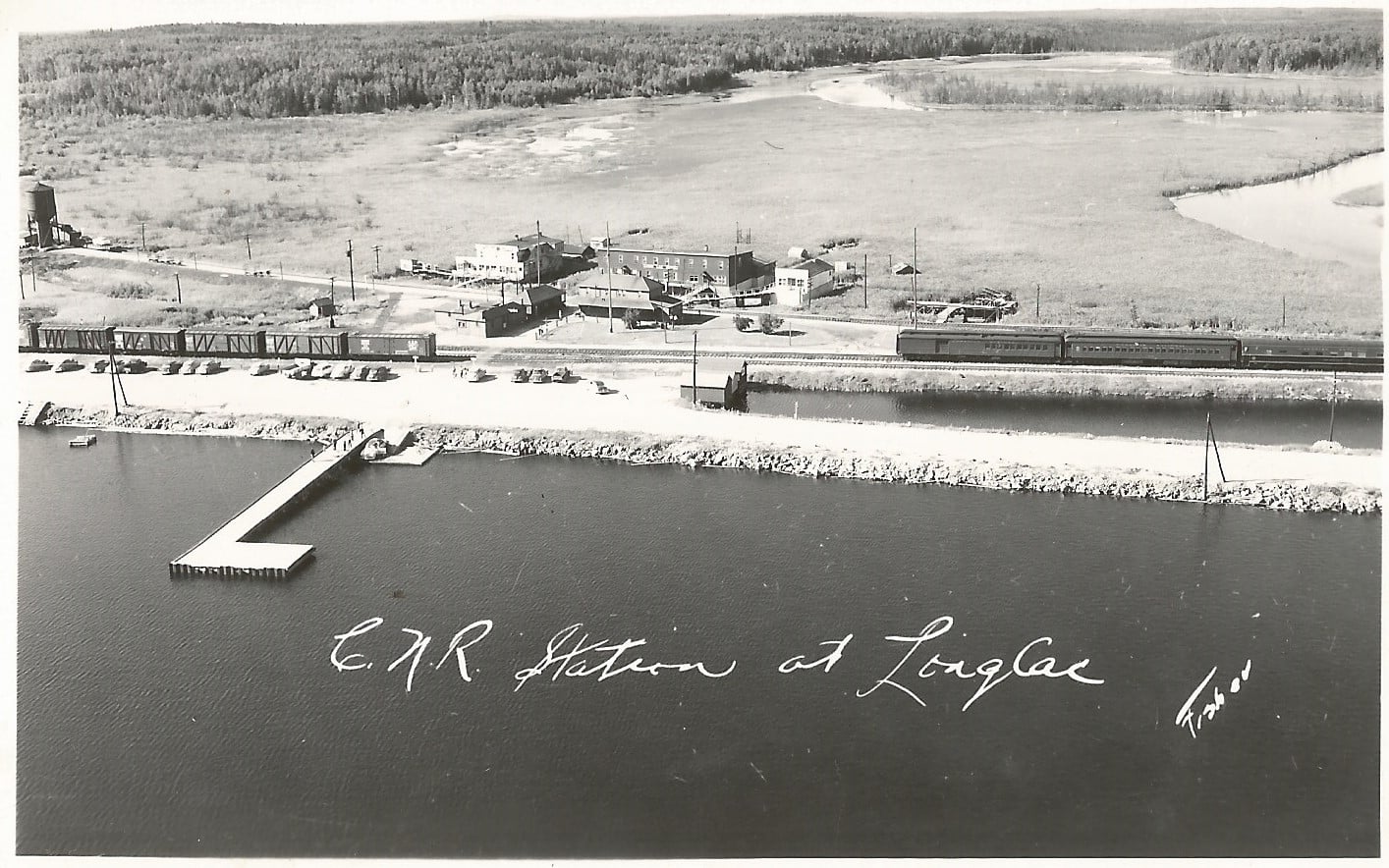
Now and then photos featuring Longlac Junction, Ontario. The first photos, courtesy of Don Loponen, were taken in the 1940s. On the left/north side sits the Canadian National Railways Caramat Subdivision, which forms part of the mainline across Canada. To the right/south side of the station, sits the Kinghorn Subdivision, which formed part of the original Canadian Northern Railway mainline. This portion of the Caramat Subdivision was opened for traffic in 1924 and was known as the “Nakina Cutoff.” This line linked the former Canadian Northern line at Longlac to the National Transcontinental line at Nakina, which shortened the transit between Toronto and Winnipeg by 100 miles.
The third photo, taken in the 1940s or 1950s, shows the station in more detail. The station at Longlac was originally located almost 1 mile to the east but was moved to this spot when the cutoff was constructed.
The last photo was taken by drone in August of 2022 looks west from the junction. The mainline Caramat Subdivision can be seen on the right while what remains of the Kinghorn Subdivision is on the left. None of the buildings remain at the site, while the Kinghorn was discontinued in 2005 and only 1.7 miles of track remains in place.



Video of the former Canadian Northern Railway/CN-Kinghorn Subdivision (MP 0) at Longlac, ON. Features one of the remaining sections of the line and an explanation of how the “Nakina Cutoff” changed the rail history of the area. Drone footage shows both current CN mainline, the Caramat Subdivision and the Kinghorn. This area was known as “Longlac Junction” from 1924 to 2005.
Part 2 of 2.
Active, 1914-2005.
Video of the former Canadian Northern Railway/CN-Kinghorn Subdivision (MP 0) at Longlac, ON. Features one of the remaining sections of the line as well as a special visitor. The location of the original Longuelac/Longlac Station is explored which lies along the current CN mainline, the Caramat Subdivision.
Part 1 of 2.
Active, 1914-2005.
Extra Credit is video series that examines topics related to history in the Thunder Bay District and exploring that history.
This episode is a follow up to our first video on the Kinghorn Subdivision. We venture outdoors to visit remains of the railway at Pass Lake, ON. This area was my first experience with the Kinghorn line and one of the first places I began making videos of it. We start at an area I call “The Cliff” (Milepost 118.7/168.4) and bike 2 miles west to the former site of Pass Lake Station. Along the way I highlight key areas of interest, including rock cuts, culverts and milepost markers.
Enjoy!
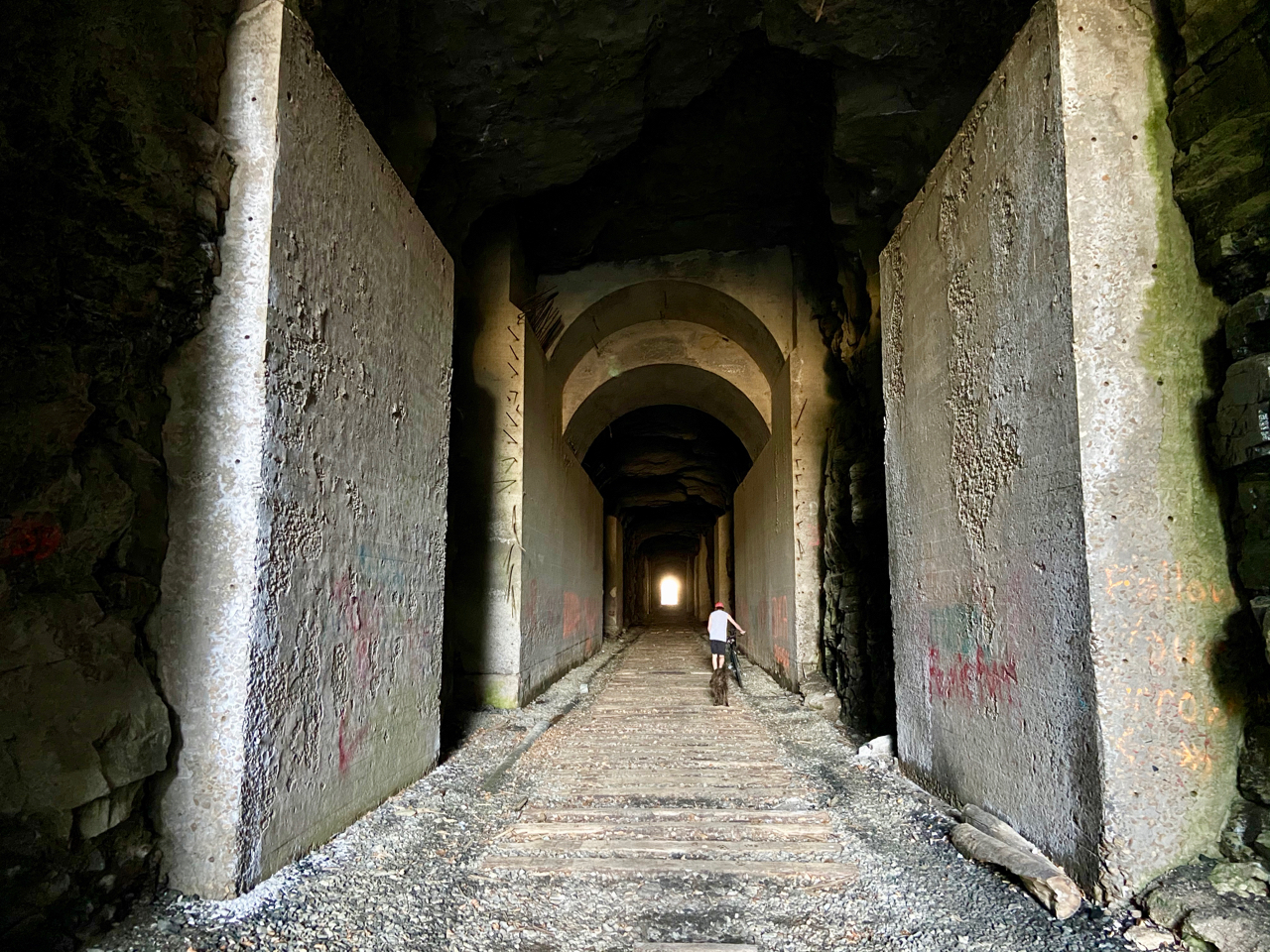
Some are familiar with the Macdiarmid or Jumbo’s Cove Tunnel, which lies north of Nipigon, ON near the communities of Macdiarmid/Biinjitiwaabik Zaaging Anishinaabek. At 1058 feet long, the former railway tunnel is one of the largest in eastern Canada and was in use from 1915 to 2005. The tunnel unfortunately has a very tragic history, the details of which have only recently been pieced together.
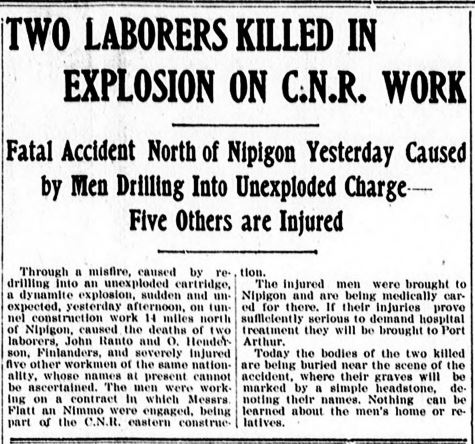
It is unknown when construction of the tunnel began, but the latter part of 1911 seems logical as work was underway in January 1912. At least two separate subcontractors were involved; Nimmo & Flatt and Chambers, McColman & Harrison. During the second half of January, accidents claimed the lives of three labourers sadly.
The first incident occurred on January 16th. A group of men led by John Ranta (Juho Kiviranta) were setting additional blasting charges after several previous ones did not ignite properly. Unfortunately, one of the earlier explosives detonated; Ranta and Oscar Hendrickson (Oskari Suosalo) took the full brunt of the blast. Their injuries can be described as nothing less than horrific. With no nearby relatives claim the bodies, the men were interred nearby in a common grave with a single headstone.
Two weeks tragedy befell the construction again. In an era before proper protective equipment, a loose piece of rock fell and struck 35-year-old Peter Rice in the head, killing him instantly. His body had to be held at the camp hospital while next of kin were notified, so it took until the end of February before his remains could be moved to Duluth, Minnesota for burial.
Many thanks to all those who helped with this important piece of local history.
Gordon Laird
Karen Johnson-Sheppard
Jerry Adams
Harold Alanen
Nipigon Museum
Michael deJong & Thunder Bay Museum
For more information on the tunnel and the incidents, please the follow page: Macdiarmid Tunnel



 Poverty, Agony, Distress & Want!