Video of the former Canadian Northern Railway/CN-Kinghorn (Dorion) Subdivision east of Pearl, ON. Features the bridge over the Pearl River.
Part 3 of 3.
Active, 1914-2005.
Video of the former Canadian Northern Railway/CN-Kinghorn (Dorion) Subdivision east of Pearl, ON. Features the bridge over the Pearl River.
Part 3 of 3.
Active, 1914-2005.
Video of the former Canadian Northern Railway/CN-Kinghorn (Dorion) Subdivision east of Pearl, ON. Features numerous long embankments and rock cuts and end alongside Pearl Lake,
Part 2 of 3.
Active, 1914-2005.
Video of the former Canadian Northern Railway/CN-Kinghorn (Dorion) Subdivision east of Pearl, ON. Features a long embankment and rock cut.
Part 1 of 3.
Active, 1914-2005.
Video of the former railway grade and station at North Lake, ON. North Lake was one of the original stations on the PAD&W line when it opened in 1893. It later saw the additions of a section house, turning wye and coal bunker. The turning wye and coal bunker were constructed prior to 1902 and the station was added in 1907.
Video of the former railway grade and station at North Lake, ON. North Lake was one of the original stations on the PAD&W line when it opened in 1893. It later saw the additions of a section house, turning wye and coal bunker. The station remains shown in the video was built by Canadian Northern Railway in 1907 and was one of their Third-Class stations. It was abandoned in 1923 and was still standing into the 1970s.
See the 1997 video for comparison (links in the video).
When life gives you lemons…you know the saying, right? And boy, we didn’t just get some lemons, we got a whole damn orchard! However, the reality is that in life, we can be consumed by our challenges, or adapt and make the best of them; I have chosen the latter. Somehow, I picture that being said by Christopher Lee playing Saruman in Lord of the Rings, you know, the White Wizard. My boys have been watching the trilogy and that popped into my head. But I digress.
Hey kids, it’s May! I can’t believe a month has flown by since my last post. This whole pandemic situation has caused me (and probably a whole lot of you too) to lose track of the days. It seems like those days and the weeks have just blurred together. On that note, I hope everyone is staying safe and making the best of the situation, as I am trying to do. It’s certainly a crazy time in the world and it has radically transformed all of our lives.
So, since it’s May, school is still in session, and just like the world, has devolved into something none of us have ever seen before. At the time of my last post, we were just starting back up after a three-week shutdown. Well, it’s now been a month of this distance, emergency learning situation and many of us in the education world are still struggling to manage this new reality. It is very strange…I really miss “teaching” a lot of this material. Posting information, video links and a few assignments is not the same; the explanation, the discussion and the personal contact is what makes it come alive. However, it’s the best we can do right now and hopefully the kids are getting something out of it. Maybe some semblance of “normality” will return in the fall.
Thankfully, the weather right now has made things a little more bearable. It hasn’t always been super warm, but almost all of the snow is gone (it is May for God sakes) and it’s only going to get better. At the moment our temperatures are below normal as part of the dreaded “Polar Vortex” has settled over Ontario, bringing with it cooler temperatures (there were some snowflakes coming down yesterday). However, I’m happier that it’s been dry, which makes it easier to get out of the house…I can always put on a jacket. I’ve been trying to get as much fresh air as I can with walks, bike rides and hikes.
On the railway front, things have been rather busy. I did as much writing and research as I could on my book, so I turned my attention to other things, including this site. Have you ever explored some of the tabs at the top? There are more now, and all of them work! Many have sub-sections to them, particularly “Stations” under the “Line” tab. It has involved quite a bit work, but its finally becoming the hub of information I want it to be.
Since we were speaking of hikes earlier, it’s the one thing that I’ve been able to take some solace in. Here in Ontario we had been asked to restrict unnecessary travel, so I’ve been limiting myself to the local area, but there’s still lots to see. I’ve gone out to visit places I had not seen in years, or had been planning to get back to but had not had the time. I actually have a list (go figure, me with a list) that has 20 places I want to visit, and I’ve been able to cross off 4 so far.
So, where have I been? Well, I’ve been on six separate “hikes” this past month, ranging from a few hundred feet from the road to ones lasting several hours. As much as it can be strenuous and exhausting, I am in my happy place when I’m hiking an old railway line. Even if I’ve been there before, I still have the same giddy exhilaration of being in the outdoors and seeing all of these efforts that were done a long time ago. Let’s take a look at them, shall we?
Alright, so I did one rather close to my house, and it involved a still functioning railway structure. If I was going to work, I would pass over a swing bridge on the Kaministiquia River twice a day. This bridge was built by the Grand Trunk Pacific Railway in 1907-1908 for their Lake Superior Branch, and via an agreement with the then City of Fort William, it also carries vehicular traffic. It’s less than a 20-minute bike ride from my house, so I figured I could kill two birds with one stone…railway and exercise. I felt a little odd standing around taking pictures and video, but it was a nice trip.

GTP Swing bridge over the Kaministiquia River, date unknown. (G. Spence)
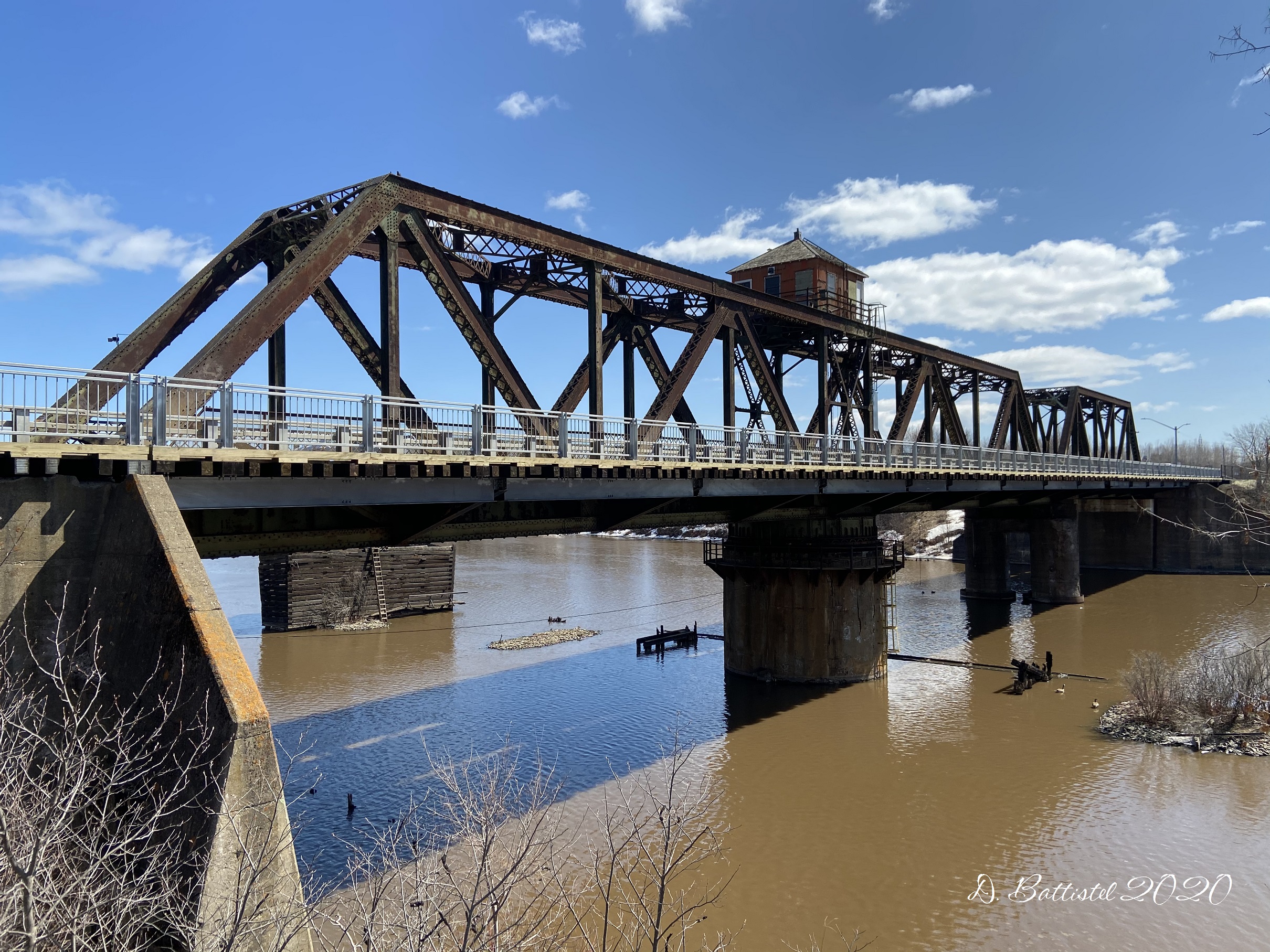
CN Swing bridge over the Kaministiquia River, April 2020.
Around that same time, I decided stop in Rosslyn while I was out on an errand. Here, just east of the village, could be found the last remaining rails of the PAD&W. Unfortunately, I was in for a big and depressing shock. When the line was abandoned in 1938 and the rails removed, 1.74 miles of track was left from Twin City Junction to the Rosslyn Brick Plant. In 1989, most of those rails were removed, except for a small 2000-foot section used as a spur. I last stopped there in 2012 to photograph and record those rails; to my dismay, at some point last year, most of those last rails were ripped out. What is left no longer connects to the CN mainline, so sadly, the last vestige of the PAD&W is now gone after 130 years. I know it was inevitable, but it does make me a bit sad.

Twin City Junction, April 2020.
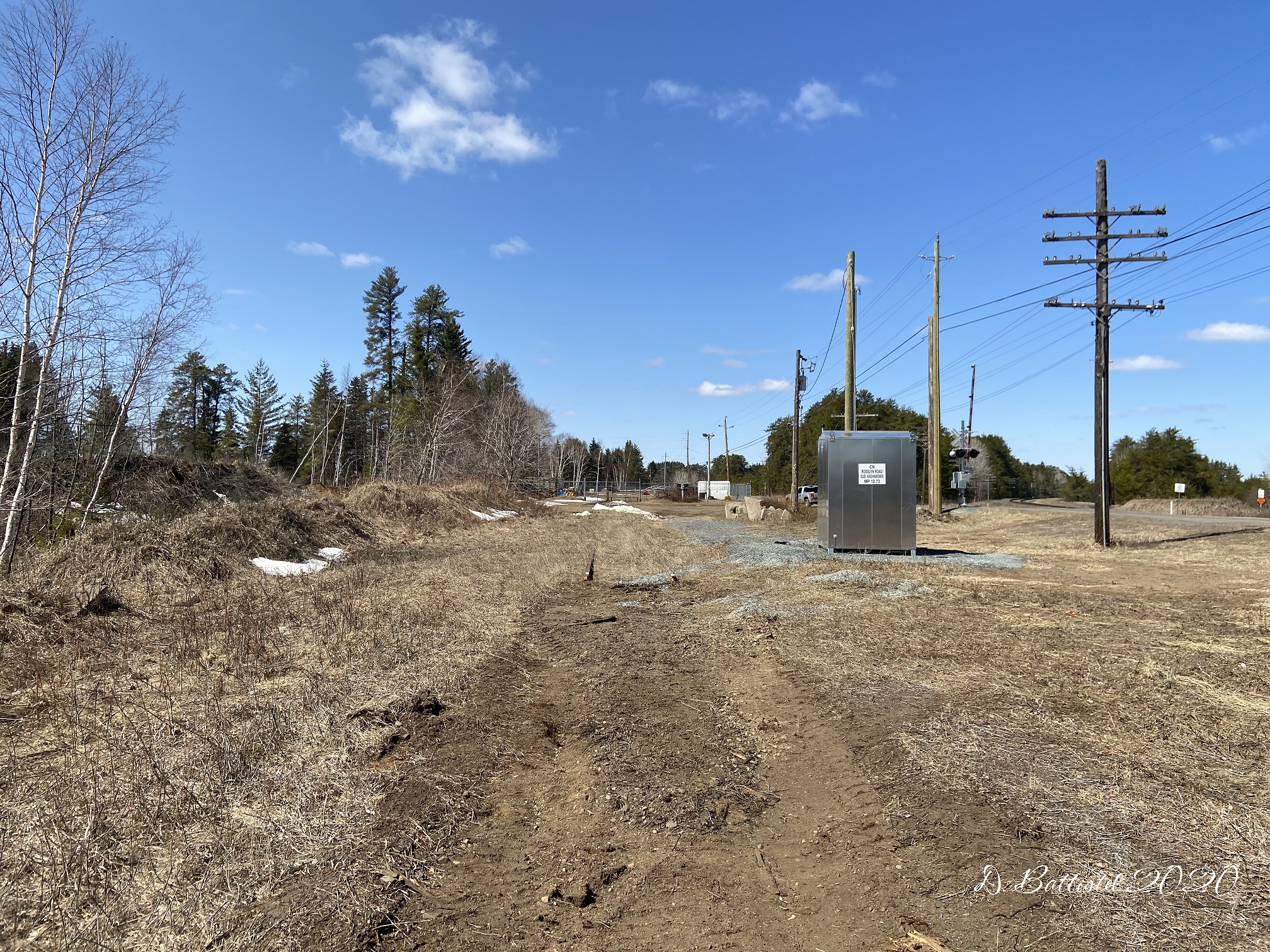
Twin City Junction, April 2020.

Twin City Junction, April 2020.
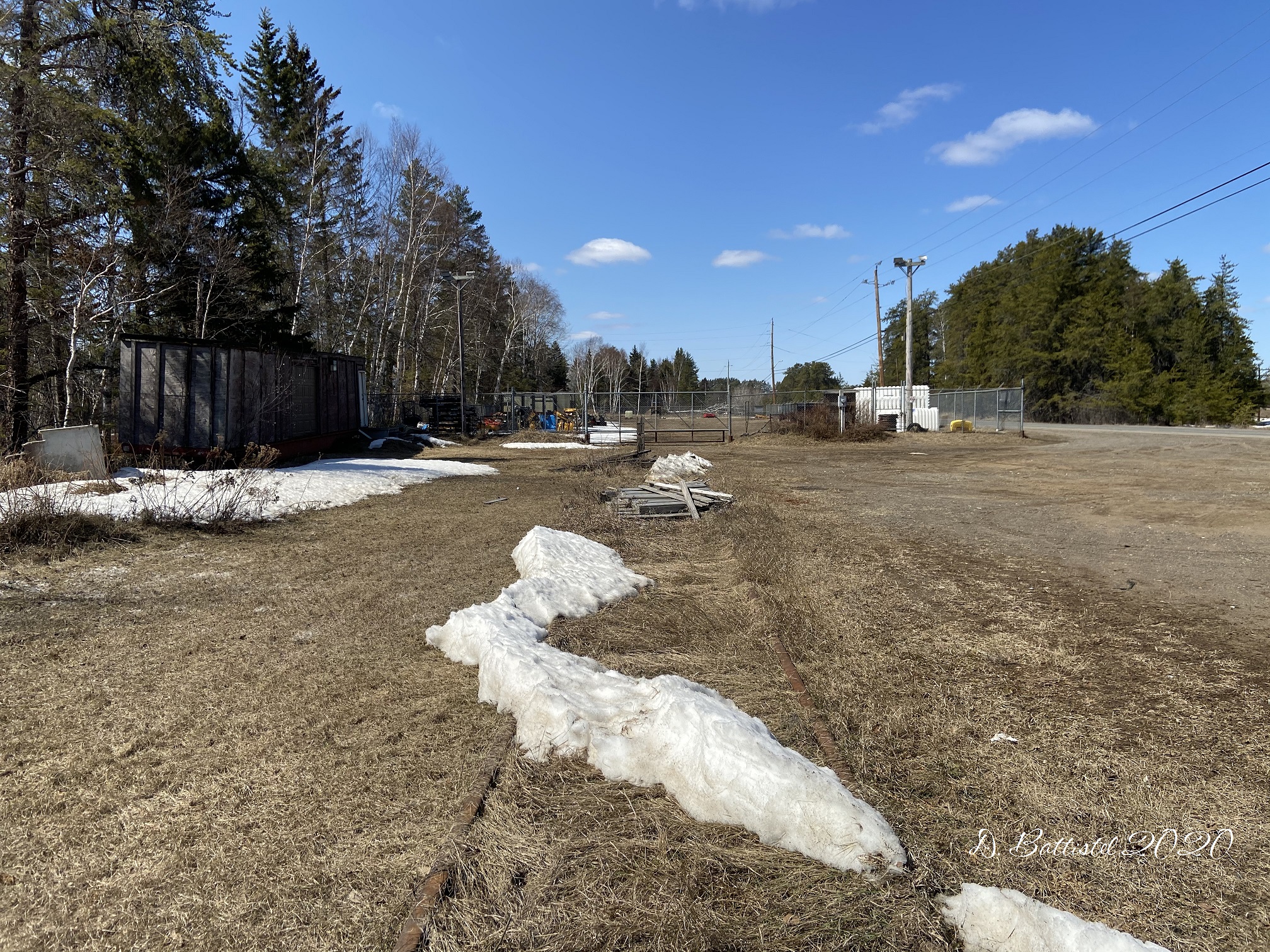
Twin City Junction, April 2020.
Another one of my trips took me further west from Rosslyn to Stanley. It was one of the original stops on the PAD&W, but it took on more importance after 1899. That year, Canadian Northern began construction on their line to Winnipeg, and Stanley would become the junction for the two lines. It remained the junction until 1911, when a new line from Twin City to Kakabeka was opened, which bypassed Stanley. The section from Stanley to Kakabeka had bad grades, and it became known as “High Track.” Places like Stanley are interesting as they have reverted, instead of growing. It is really neat to compare old photos of the village and what it looks like today.

Stanley, circa 1900. (Duke Hunt Museum)
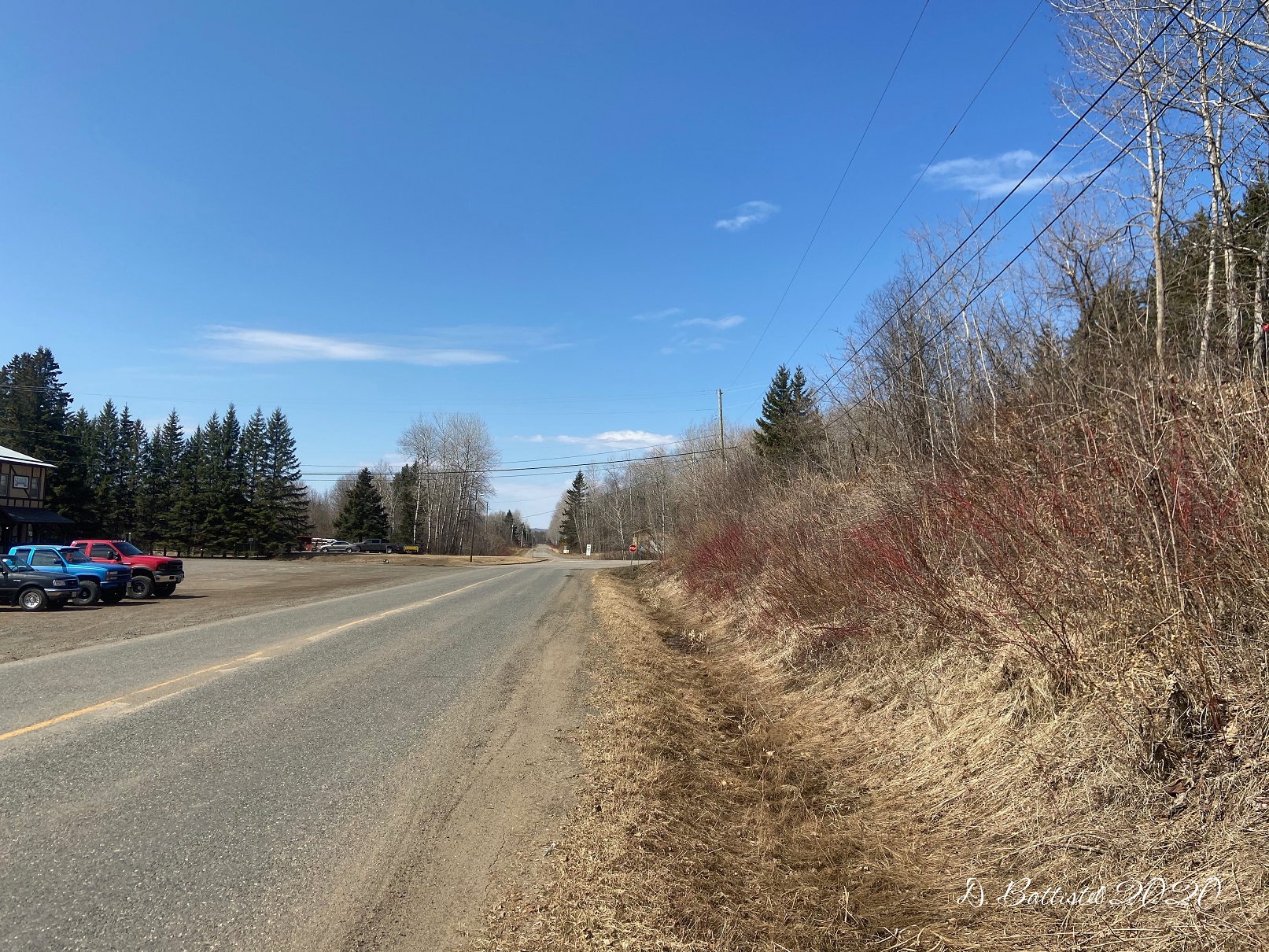
Stanley, April 2020.

Stanley, April 2020.
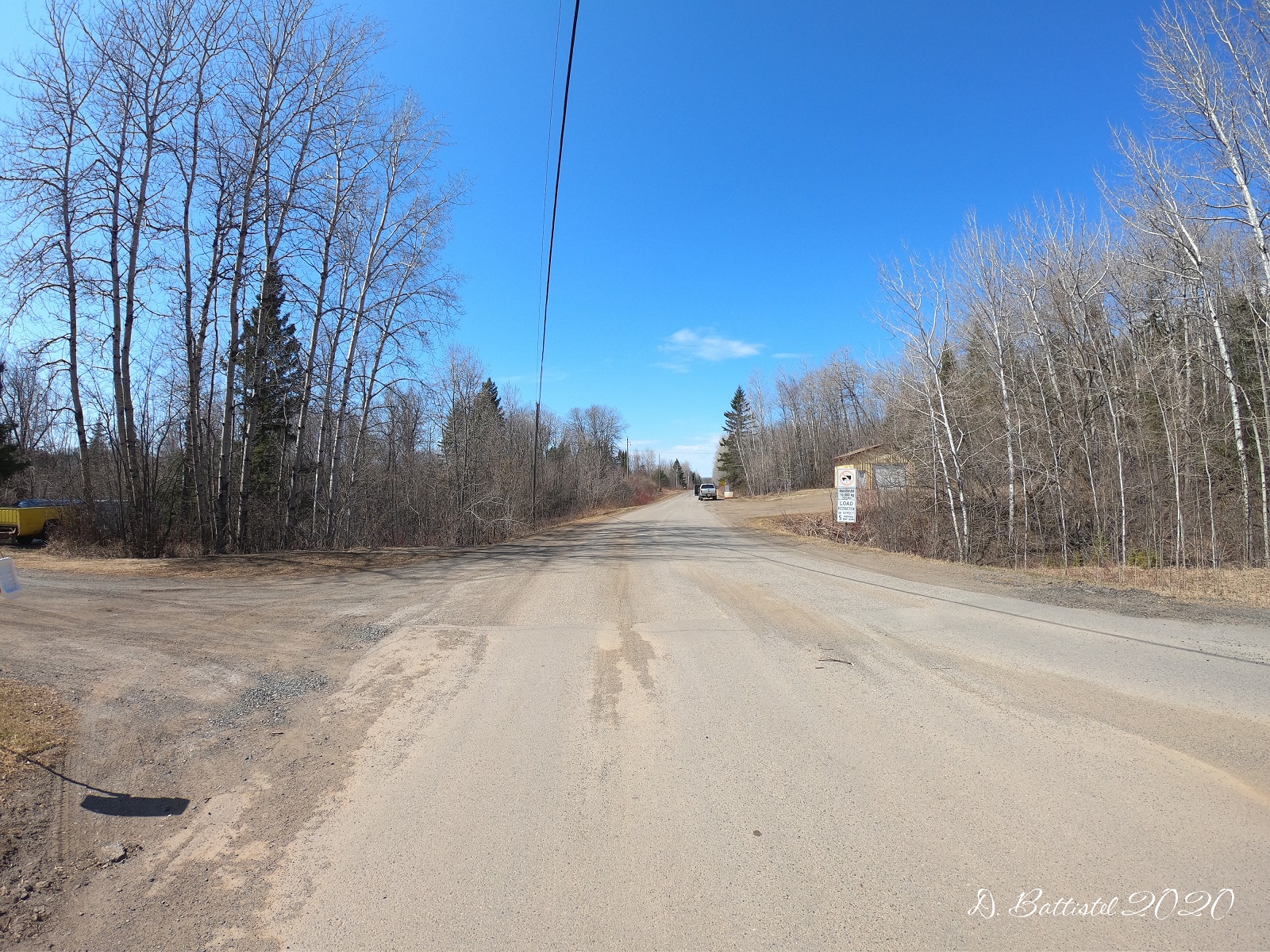
Stanley, April 2020.
Speaking of High Track, I had not been to that area in a long time, like mid-90s long time. There have been a few little, quick excursions, like I did in March, but I really want to trace the line as far as I could. It would give me an opportunity to gather GPS data and take video as well. It started off a little challenging, since I could not find the grade for a bit. A good chunk of the grade in this area has been over taken by gravel pit operations, so I had to spend some time looking around. It certainly is well defined at a spot known as “The Oaks,” which features a large stand of Bur Oaks which are not native to this area. Beyond there, it is fairly easy to follow. Eventually it gets into an area where there are several long embankments, one of which is well-preserved, and the others have suffered washout damage. Then it was on to spot that I remember well from my hike way back in the 90s; a stretch with ties still in their place. It’s really too bad this line was abandoned, as it goes through some very nice terrain alongside the Kaministiquia River. There is still another piece I’d like to follow, but that one will take me through what is likely private property, so that will have to wait.
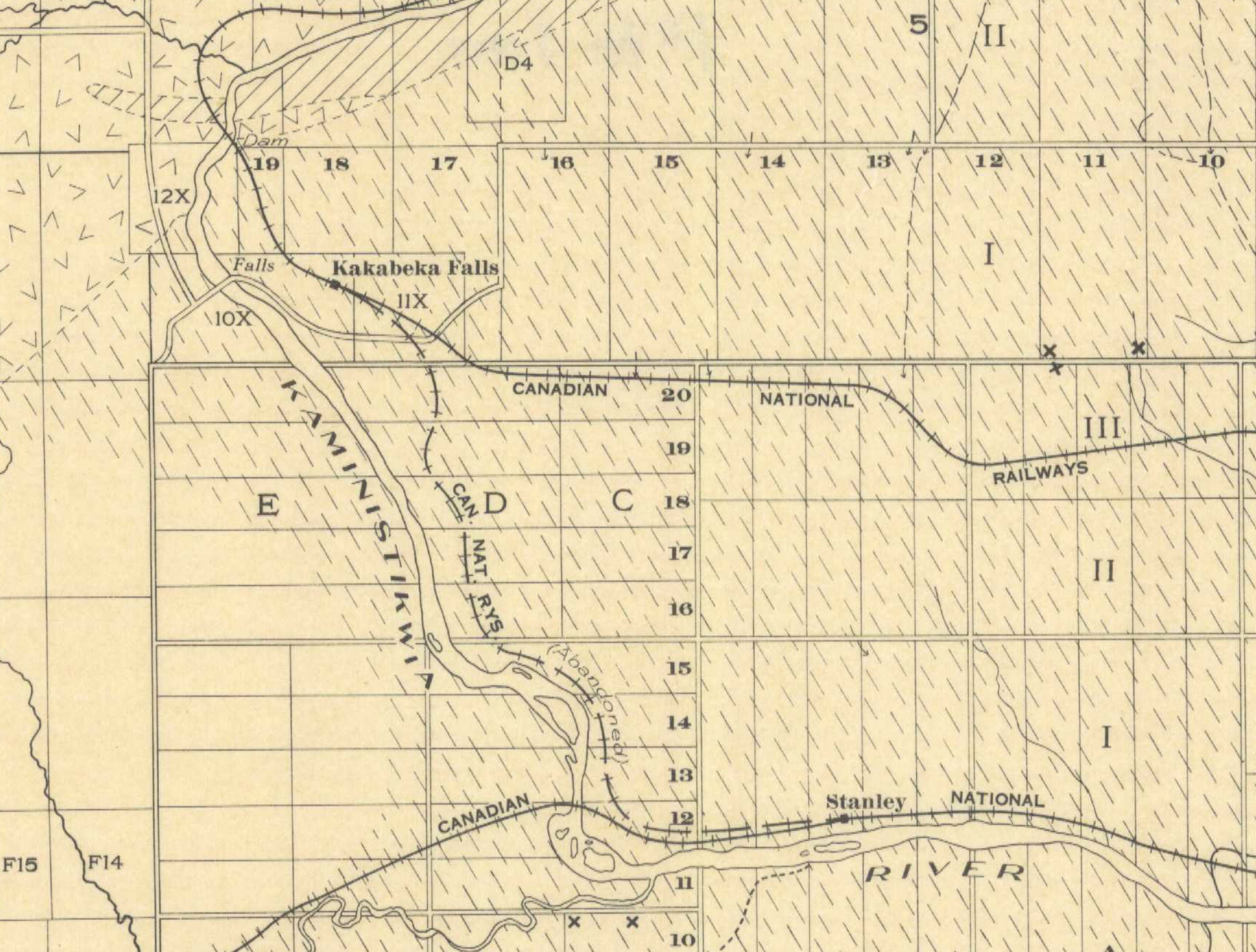
High Track 1928 (GSC)
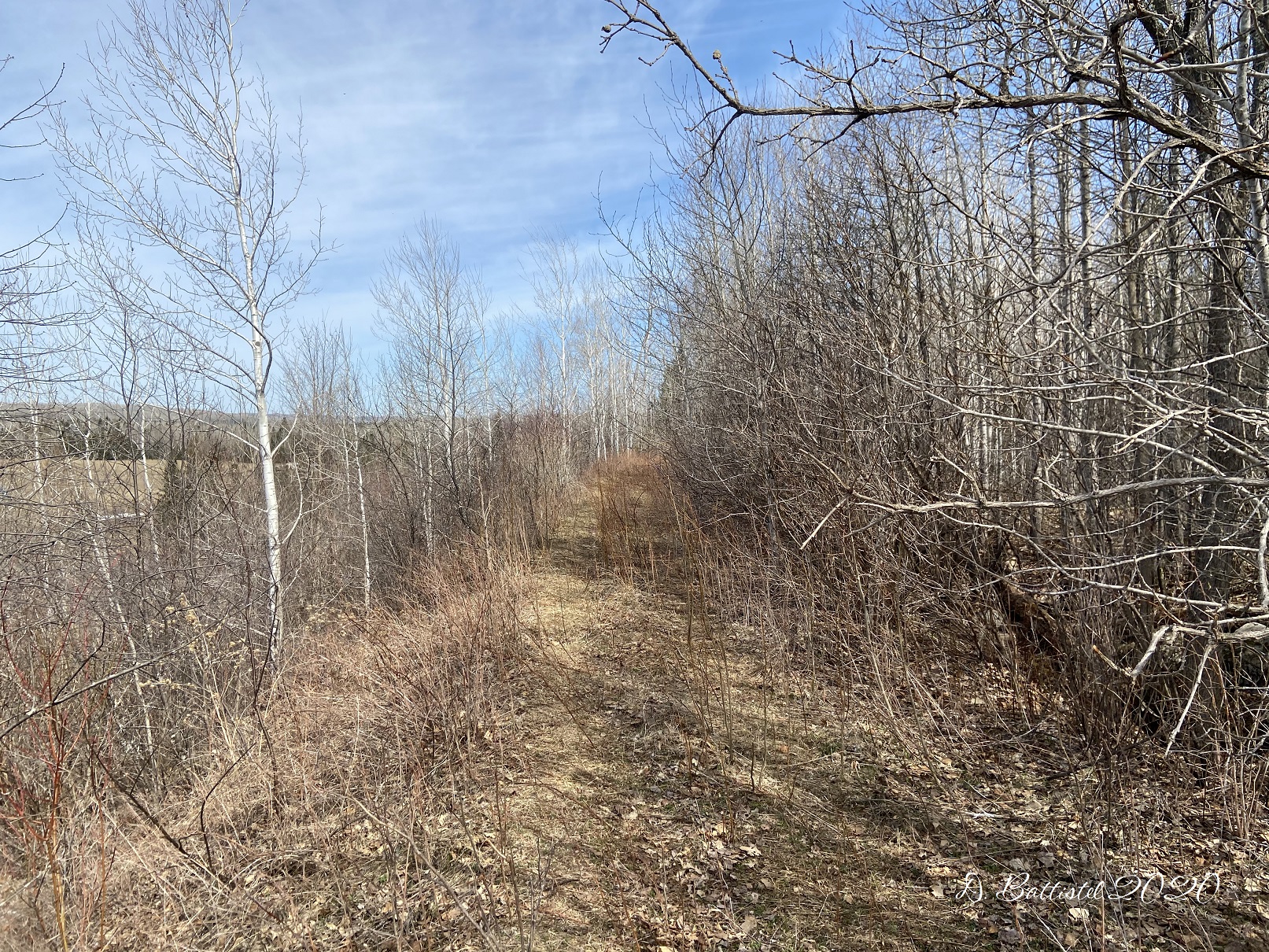
High Track, May 2020.

High Track, May 2020.

High Track, May 2020.
The last hike I did was actually two separate hikes in an area known as the “Moose’s Nose.” It’s rather interesting nickname for a section of railway, but the name certainly fits. It was formerly part of the GTP, which had very strict requirements regarding its grade. In order to negotiate the grade west of Thunder Bay, the engineers built several big sweeping loops which would allow the railway to climb and keep the grades in check. This area near Mapleward Road in modern Thunder Bay, acquired the nickname because of its appearance; it’s also referred to as the “Devil’s Elbow.” So the explorations I did were hikes n’ bikes, walking part of the grade and biking back. Besides its layout, the grade here goes through a very pretty area and also contains some neat structures, particularly a number of concrete culverts that were built in 1917. Unfortunately, only two of the original three remain, as one was removed and replaced with a steel culvert…sad.

Moose’s Nose 1925 (GSC)
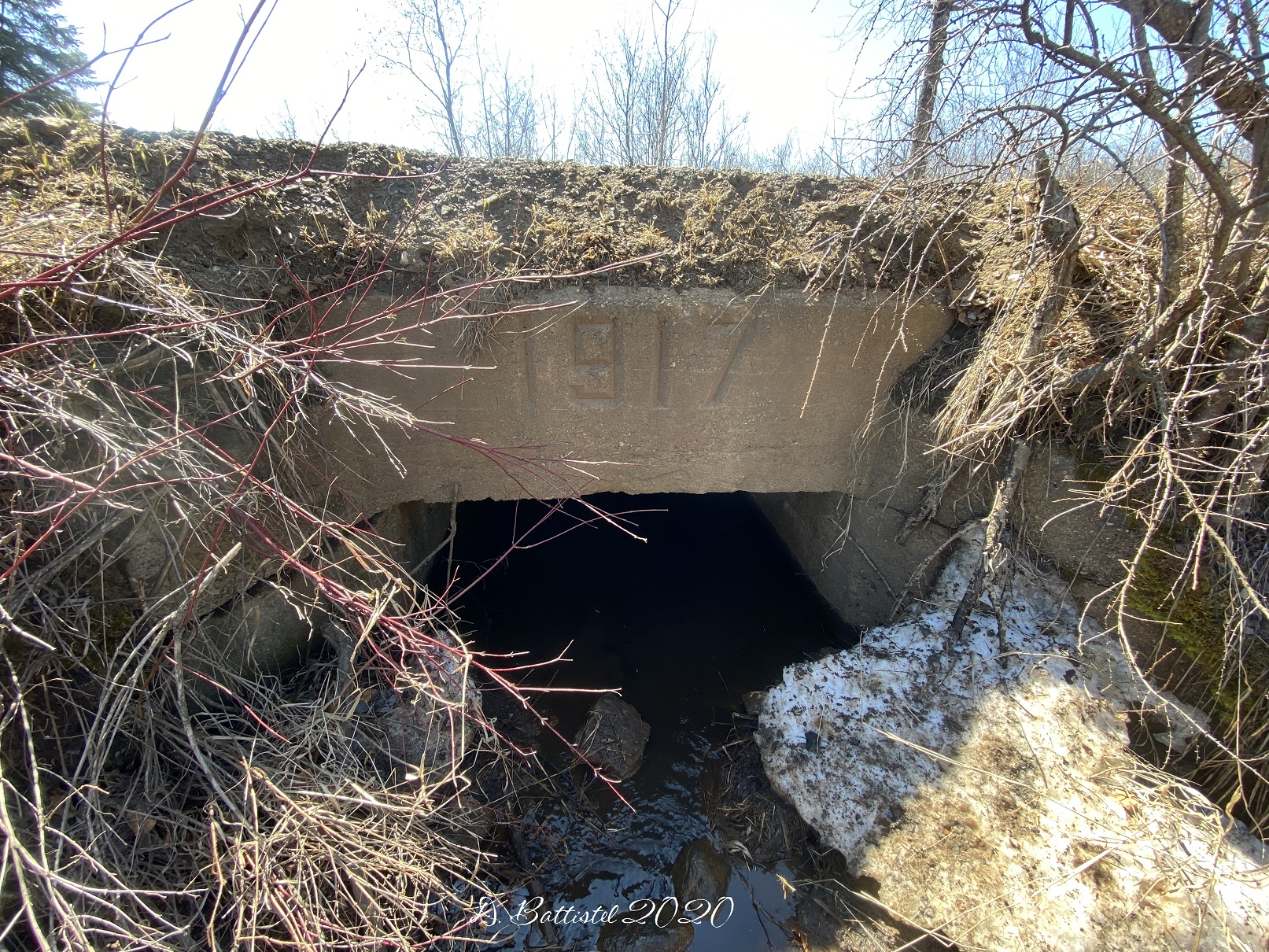
Moose’s Nose, April 2020.
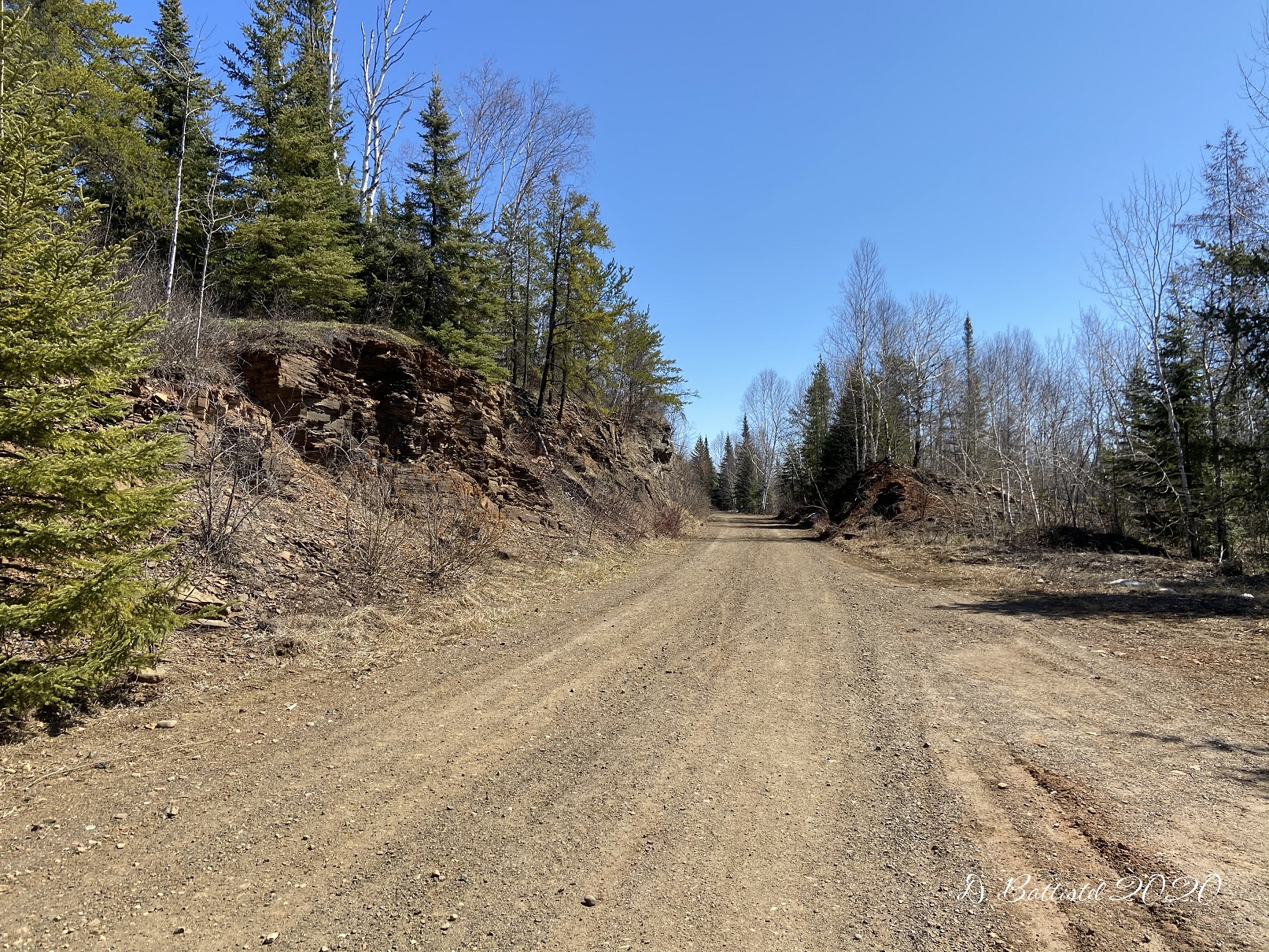
Moose’s Nose, April 2020.
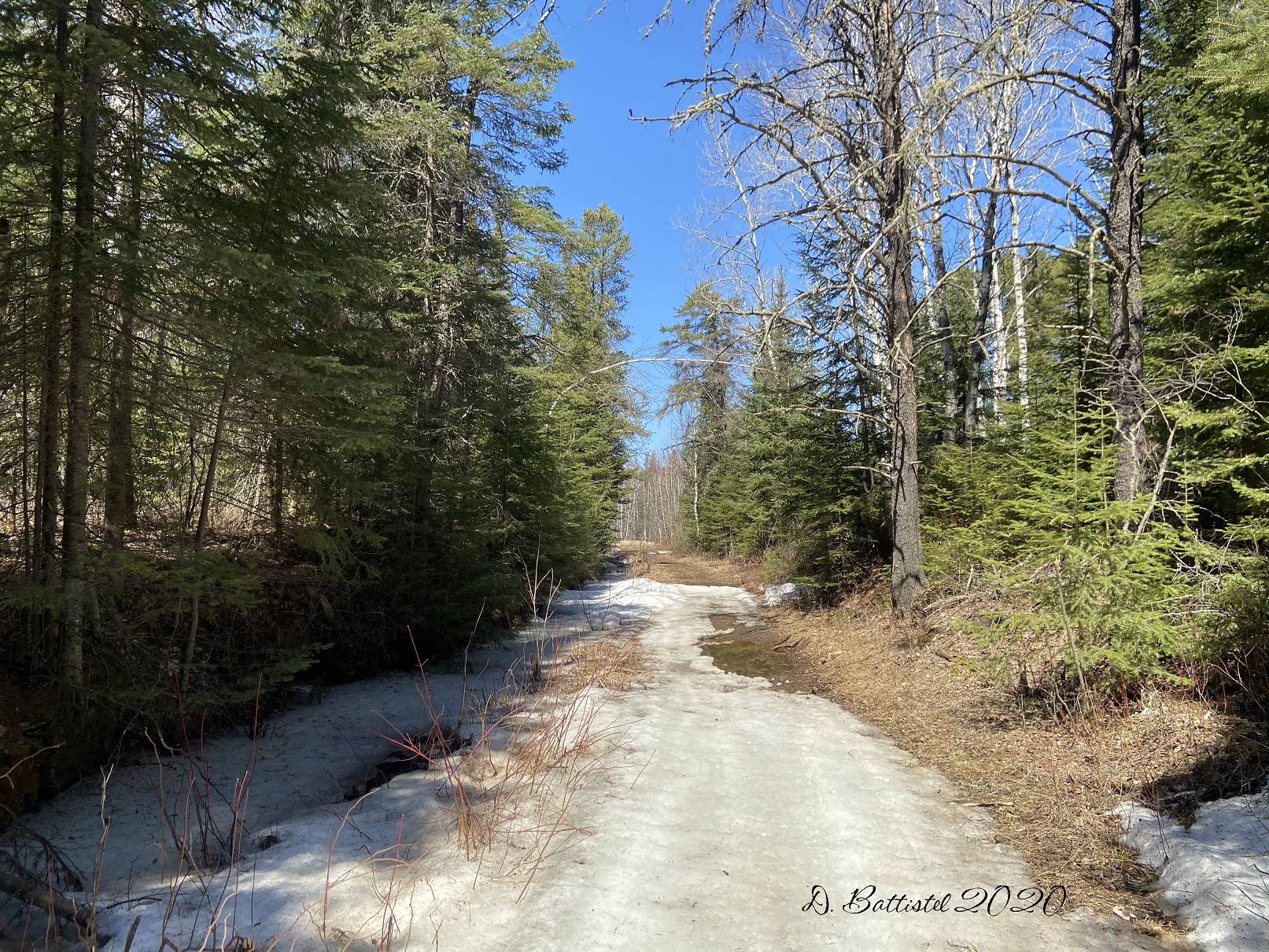
Moose’s Nose, April 2020.

Moose’s Nose, May 2020.
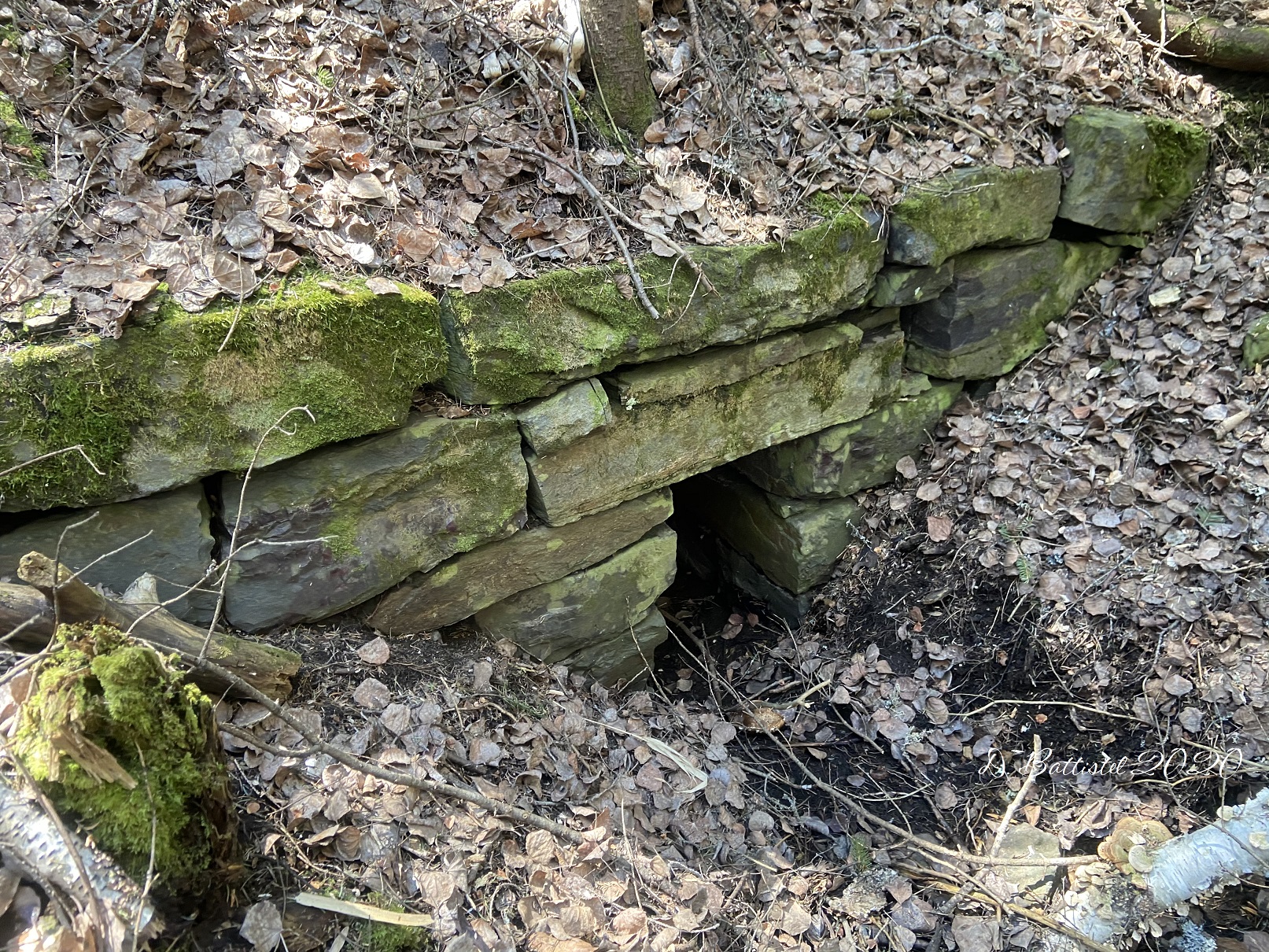
Moose’s Nose, May 2020.
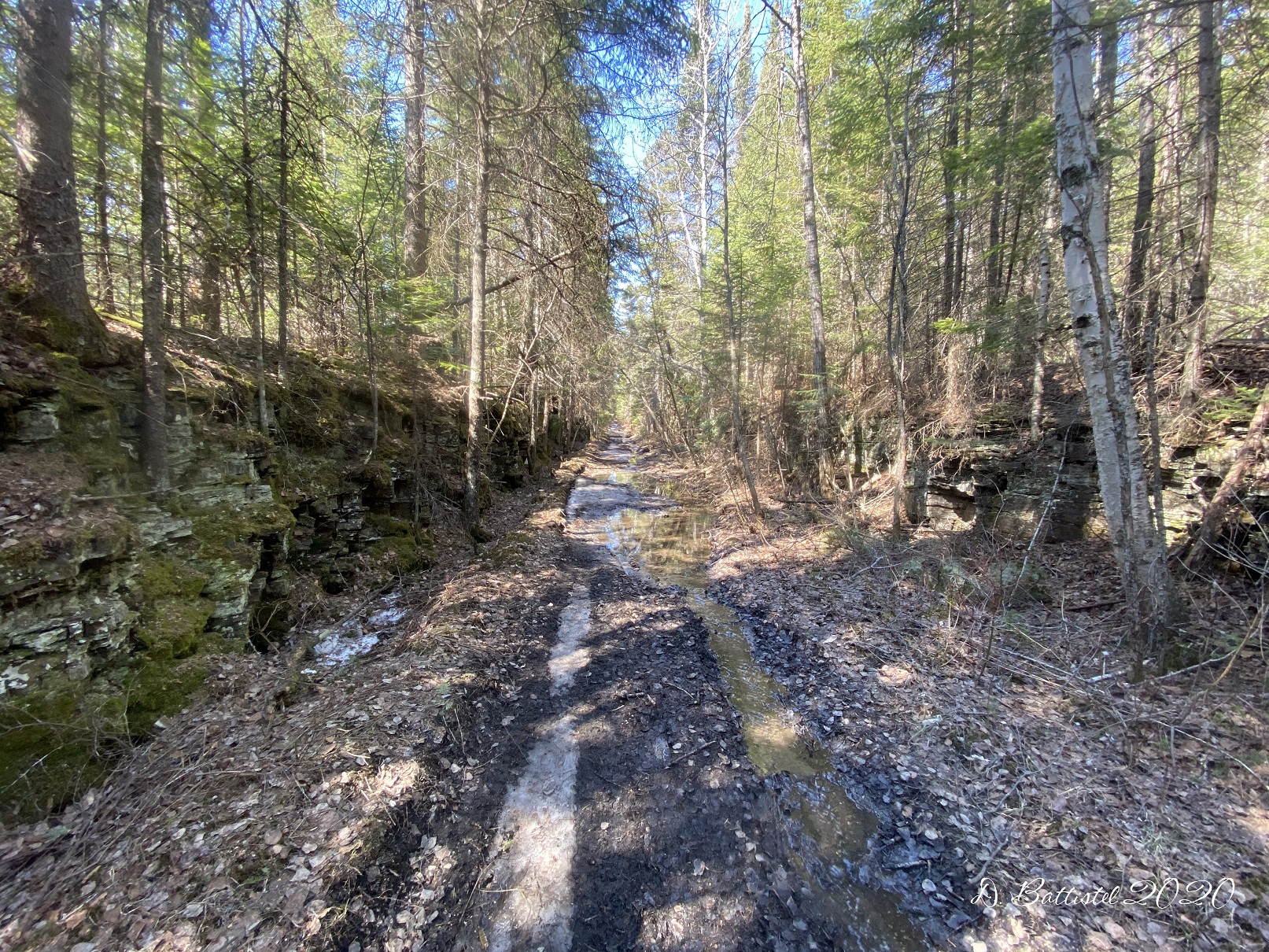
Moose’s Nose, May 2020.
Now remember I still have 16 other hikes on my list, and I’m hoping I can get to most of them before winter. If the weather holds, I’ll be back out tomorrow, heading down to one of my favourite places, North Lake. I was there several times in the fall, but on the west end of the lake. This visit will be centred around the station, and exploring a spot I have not been around since 2011. Next week is also the Victoria Day weekend here in Canada, so that’s means my weekends moving forward will be spent more often out at camp, so there will be further explorations of the CN grade to the east. So much history…so little time!
Anyway, it’s time to move along. I’ll probably be back in a few weeks with the latest updates and photos. I can’t wait to share what I’ve found on all these hikes. Until then…
Video of the former railway grade at Stanley, ON. Stanley was a major station on the PAD&W from 1889 to 1899. When Canadian Northern began construction on their line to Winnipeg, it became the junction point between the two lines. However, in 1912, a new route was opened from Twin City (MP 11.8) to Kakabeka which bypassed Stanley. Its importance declined, though it remained a station until 1938 when the PAD&W was abandoned.
Video from Saturday’s hike at Iron Range Hill, between Mileposts 59 and 60.5.
Iron Range Hill, between Sandstone and Iron Range Lakes, had the heaviest grade on the line at over 2 percent. There is a famous series of photographs taken of the hill in 1915-1916 showing a train stuck in deep snow on its way to North Lake (MP 71).
In the video I mistakenly refer to the Height of Land as the end of this section. In fact, the Height of Land was further down the line, west of Iron Range Lake. The top of IRH and the Height of Land have a similar elevation.
Video from Saturday’s hike at the former PAD&W bridge west of Stanley at MP 20.
This bridge is the last remaining structure on the railway, and was built in 1922. At the time, the line was part of Canadian National Railways, and was known as the North Lake Sub-Division or the North Lake Branch. It was the third bridge at this location; the original was constructed in 1889 and the first replacement installed in 1902. The last train rumbled over it in March 1938, 82 years ago this month. The whole line was abandoned in October of that year.
It was converted to vehicular use at some point afterwards (for sure before 1960) which it continues to faithfully do. The bridge is in need of some repair, which hopefully occurs soon to keep this great reminder of the railway operating well into the future.
Available in 4K (though it may not be available due to YouTube lowering bandwidth worldwide).
A video of 300-foot rock cut on the Port Arthur, Duluth and Western Railway near Round Lake, MN.
 Poverty, Agony, Distress & Want!