Extra Credit is video series that examines topics related to history in the Thunder Bay District and exploring that history.
This episode, the eleventh in sub-series on the former Kinghorn Subdivision and Part 2 of 2, takes us to Pass Lake, Ontario and one of the most recognizable structures on the line. The Pass Lake-Blende River area has some unique geography and that influenced the route and construction of the Canadian Northern Railway. Forced by the Canadian Pacific Railway and the ridges of the Sibley Peninsula to hug the shore of Lake Superior and then through a narrow gap known as “The Pass,” the rail line had to cross the wide Blende River Valley. The result was a massive, 2258-foot long, 130-foot high steel viaduct, which remains the largest in central Canada. Our ride takes us from the west side of the viaduct along the grade through several large rock cuts to Nelson Road.
Extra Credit is video series that examines topics related to history in the Thunder Bay District and exploring that history.
This episode, the tenth in sub-series on the former Kinghorn Subdivision and Part 1 of 2, takes us to Pass Lake, Ontario and one of the most recognizable structures on the line. The Pass Lake-Blende River area has some unique geography and that influenced the route and construction of the Canadian Northern Railway. Forced by the Canadian Pacific Railway and the ridges of the Sibley Peninsula to hug the shore of Lake Superior and then through a narrow gap known as “The Pass,” the rail line had to cross the wide Blende River Valley. The result was a massive, 2258-foot long, 130-foot high steel viaduct, which remains the largest in central Canada. Our ride takes us from the site of Pass Lake Station west to the viaduct, including through a stretch where the rails remain in place.
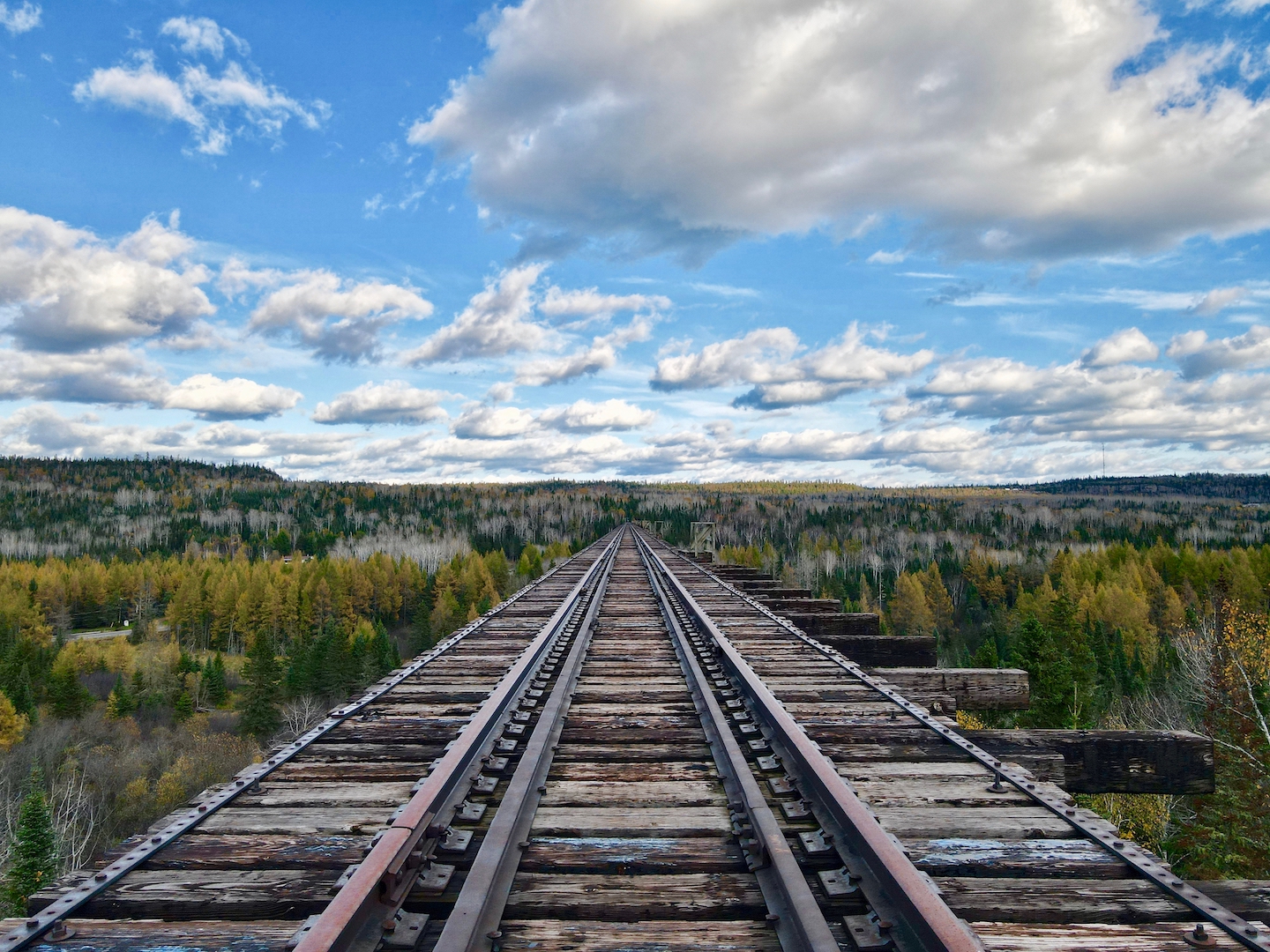
Video of the former Canadian Northern Railway/CN-Kinghorn (Dorion) Subdivision (MP 173.1-175.1) at Pass Lake, ON. Features western side of the Blende River Viaduct/Pass Lake Trestle where several rails are still in place. The grade then proceeds west into a large rock cut.
Video of the former Canadian Northern Railway/CN-Kinghorn (Dorion) Subdivision (MP 173.1) at Pass Lake, ON. Features the 2258-foot long, 130-foot tall Blende River Viaduct, which is more commonly referred to as the Pass Lake Trestle. Constructed between May and December 1912, the first train passed over its spans on or around January 14, 1913 and the last in the late fall of 2008. It remains the largest railway trestle in central Canada.
Video of the former Canadian Northern Railway/CN-Kinghorn (Dorion) Subdivision (MP 170.3-173.1) at Pass Lake, ON. Features the grade west of Pass Lake Station with a rock cut, rails that are still in place. and the eastern abutment and underside of the Blende River Viaduct. At 2258 feet, the viaduct, which opened in 1913, is the largest railway structure in Central Canada.
One hundred ten years ago this week, the first train rolled over the Blende River Viaduct, which is more commonly known as the Pass Lake Trestle. Constructed between May and December 1912 by the Canadian Northern Railway, the viaduct stretches 2258 feet across the Blende River Valley and 130 feet above it.
Opened for traffic in 1915, it remained in use until 2005; the rails around the viaduct were removed in 2008. The iconic structure remains the longest railway trestle in central Canada.
Then and now photos featuring the Blende River Viaduct, more commonly known as the Pass Lake Trestle. Located northwest of the community of Pass Lake, ON, the first train rolled over its spans 110 years ago this week. In May 2005, the last regular train crossed the viaduct and the rails around it were pulled up in late 2008.
Constructed between May and December 1912 by the Canadian Northern Railway, the viaduct is 2258 feet long and 130 feet high. To bridge the wide Blende River Valley, workers poured 3600 cubic yards concrete and placed 5 million pounds of steel at a cost of $350,000. It remains the longest railway trestle in central Canada.
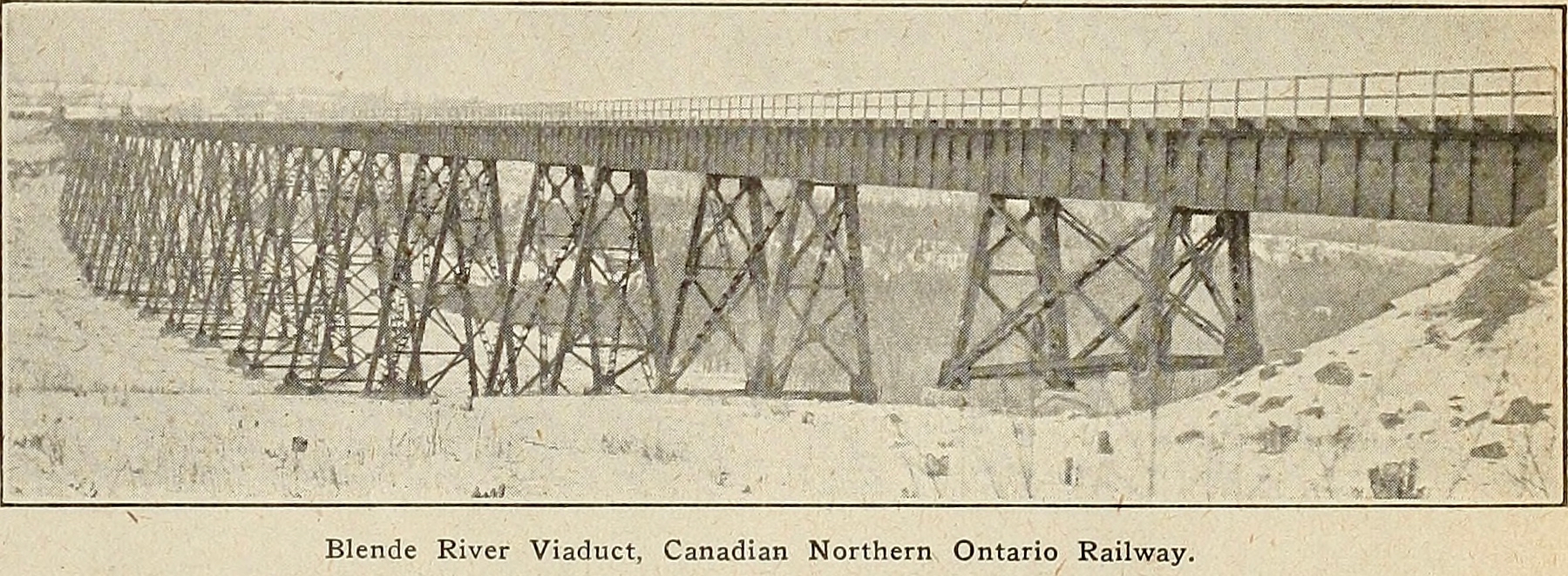
The viaduct as completed, circa 1913.Viaduct, August 2021.Viaduct, October 2021.Viaduct, October 2021.Viaduct, October 2021.Viaduct, March 2022.
Video of the former Canadian Northern Railway/CN-Kinghorn (Dorion) Subdivision (MP 173.1) at Pass Lake, ON. Features the 2258-foot long, 130-foot tall Blende River Viaduct, which is more commonly referred to as the Pass Lake Trestle. Constructed between May and December 1912, it remains the largest railway trestle in central Canada.
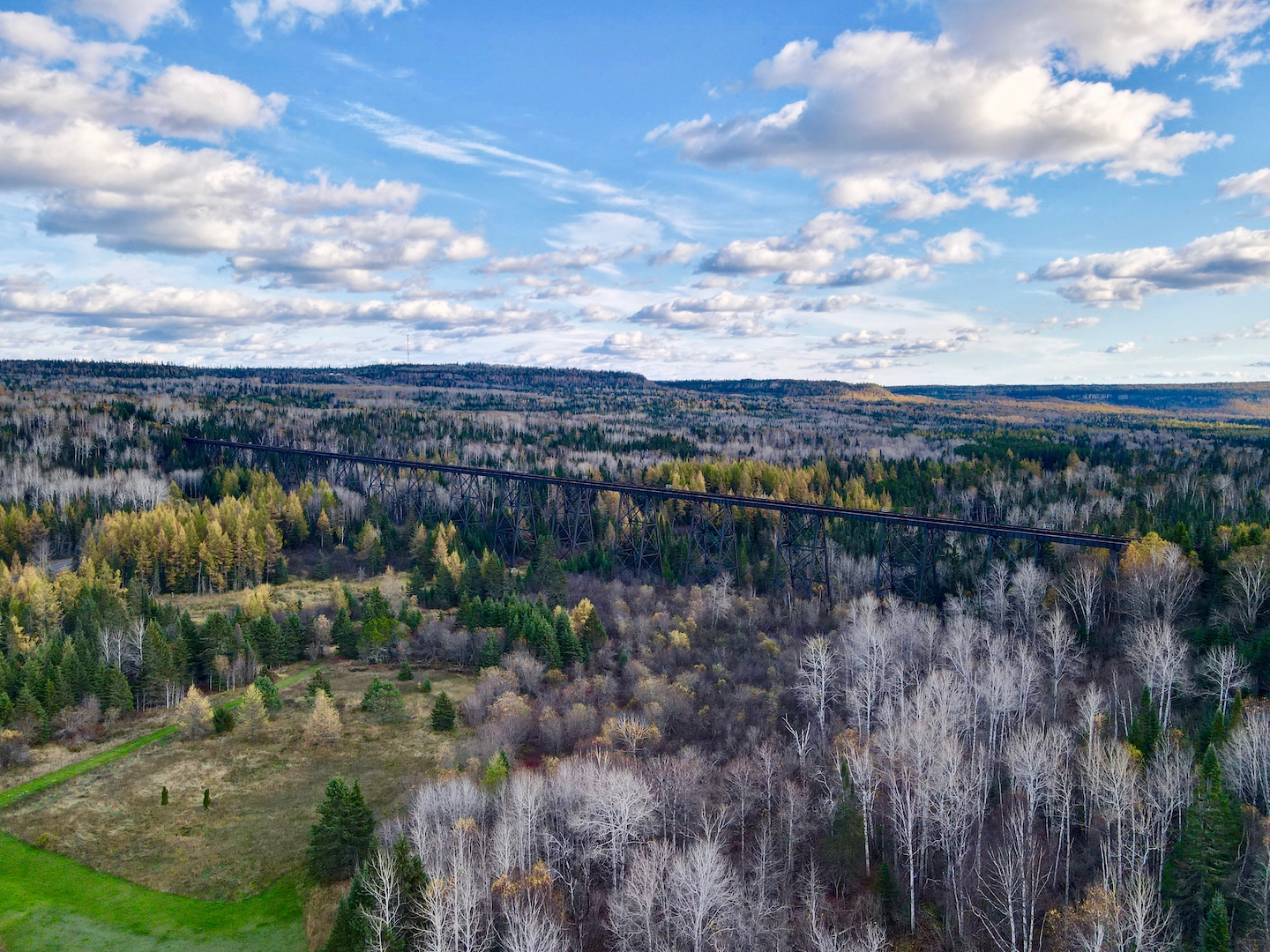
A few drone views of the Blende River Viaduct, more commonly referred to as the Pass Lake Trestle, which is a former railway structure located northwest of the community of Pass Lake, ON. These photos were taken while capturing footage for a video on the viaduct.
Built by Canadian Northern Railway (CNoR) in 1912, its construction only took an amazing 8 months to complete. It was situated at Milepost 123.4 of the CNoR-Nipigon Subdivision/Canadian National Railways-Dorion Subdivision and Milepost 173.1 of the later Canadian National Railway Kinghorn Subdivision. At 2258 feet long and 130 feet high, it is the largest railway trestle in central Canada. It saw it last regular train in May 2005.
Viaduct, August 2021.Viaduct, October 2021.Viaduct, October 2021.Viaduct, March 2022.
Taken in the fall of 1912, crews from the Canadian Bridge Company of Walkerville, Ontario assemble spans of the Blende River Viaduct (Pass Lake Trestle). This structure was one of the biggest engineering projects on the Canadian Northern Ontario Railway line built from Ruel (Sudbury area) to Port Arthur, Ontario between 1911 and 1914. Construction on the 2258-foot trestle, still the longest in central Canada, was completed in only 8 months.




 Poverty, Agony, Distress & Want!