RSS

Category Archives: Travel

Gunflint Day 3

So I’m sitting on the front deck of the lodge looking out at a beautiful evening here on Gunflint Lake. Living in northwestern part of Ontario (even though I’m in northeastern Minnesota right now) we often take for granted how lucky we are to be able to experience this amazing scenery on an almost daily basis. I wish I could live out here on this lake…it is breathtaking!

So the third day of my adventure began much better than the previous one. I woke up rather early, five o’clock exactly (central time), and decided to take a peek outside before I tried to roll back into bed. The sun was just rising over the calm lake and it made for a neat picture. Had I not been wear just my boxers I might have ventured down to the water for a better view!
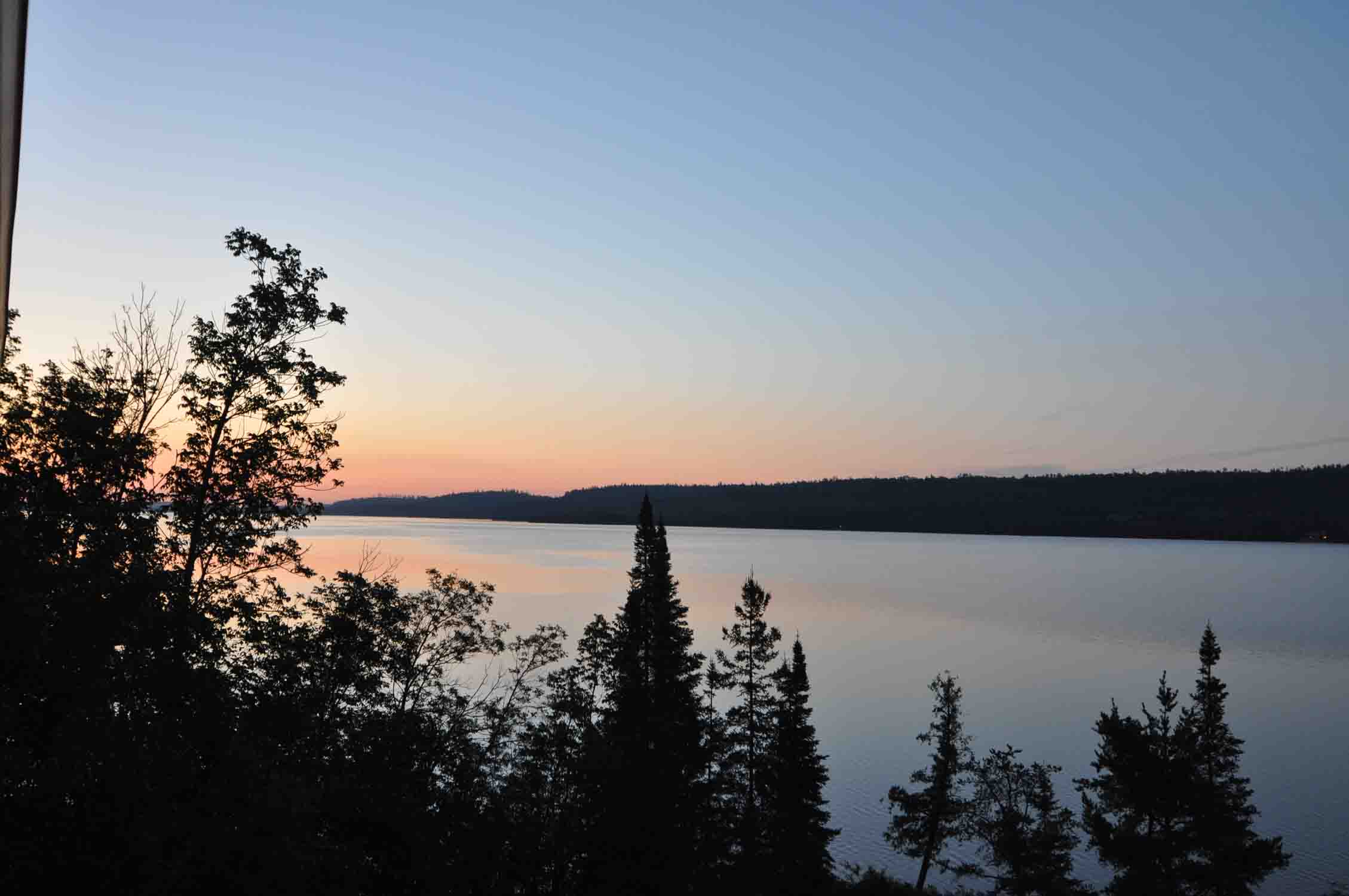
Sunrise on Gunflint Lake, August 2012.

Last night I promised my host John that I would stick around for his hot breakfast at 8. He was actually early, so I had a filling meal of eggs, sausage, bacon and fresh strawberries. After that it was straight to the boat, and off across the lake to my first destination, the ghost town of Leeblain.

Since the lake was relatively calm, I was able to crank the boat up to full speed, 39kph, which made my trip much faster. With the wind cooperating, I decided to make a short detour and take a quick look at some of the rock cuts along the shore of the lake. After setting up the fish finder, I puttered along the shoreline a bit until I reached what I was ultimately looking for. The water depth ranged from 7 to 25 feet, but I really wanted to re-visit the retaining wall site.

In this location, the railway grade was blasted right out of the shoreline of the lake. However, unlike in other places, the water depth necessitated the use of some elaborate iron and wood retainers to keep the rock fill from sliding into the lake. The engineers pinned and buried large metal rods under the grade, and inserted thick iron bars through the loops and in front of wood timbers. It is amazing to see most of these items still in place after 120 years!
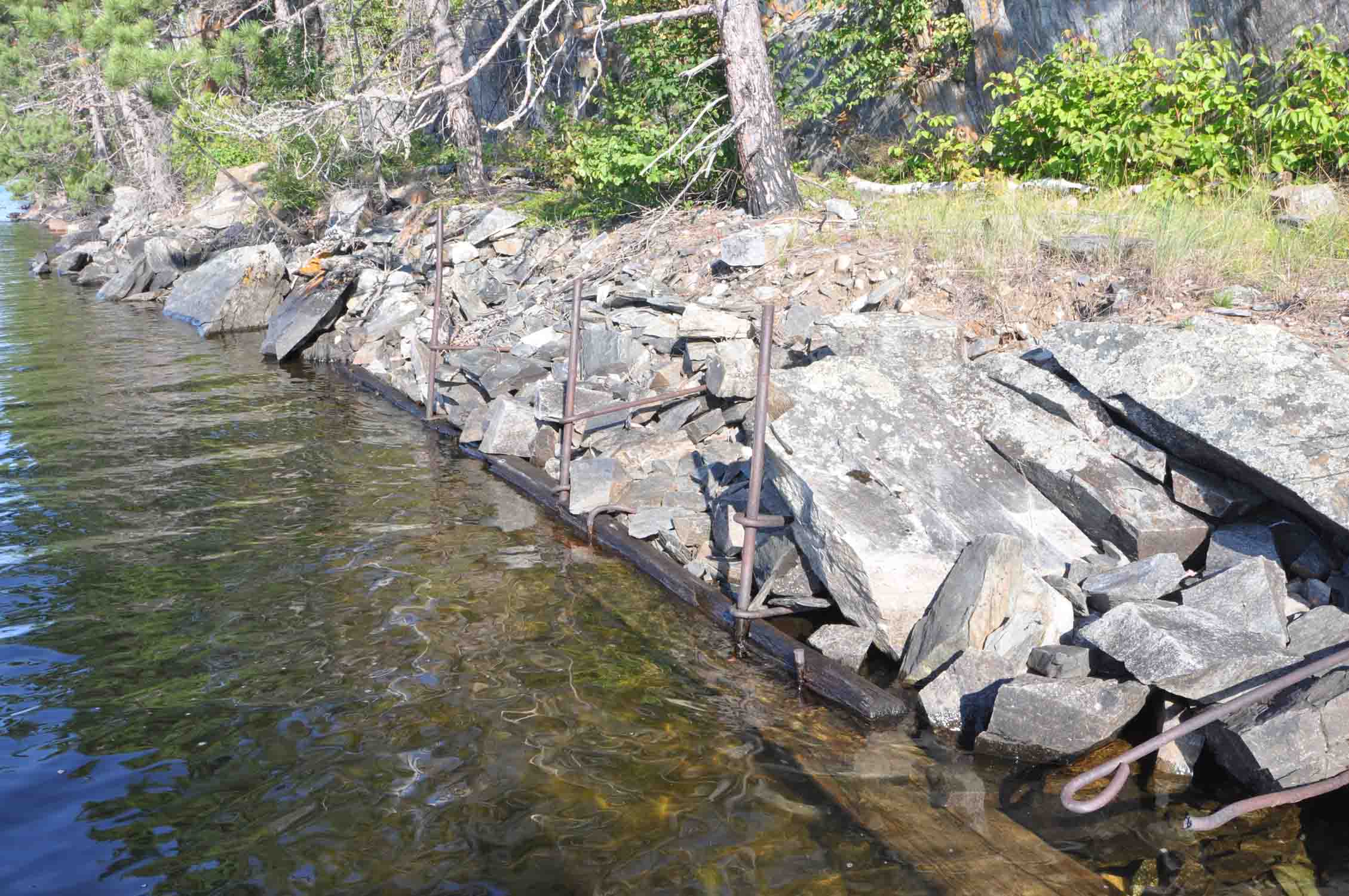
Retaining wall, Gunflint Lake, August 2012.

The water depth right beside the wall is 13 feet, but as you move away from shore it drops very quickly. Ten to fifteen feet out it is at 25+ feet and by 30 to 40 feet the depth plunges to a jaw-dropping 90+ feet! I wonder if they knew this beforehand, or did they run into problems after they tried running a train by?

After this short mini-adventure, I turned the boat around and headed west to my original destination. On the way I passed by Dynamite Island (which I just learned the name of a few days ago). During the construction of the railway, the powder house was apparently located on the island to ensure minimal damage in the event there was a catastrophic detonation!

With my previous day’s struggle in mind, I was thankful to be beaching my boat at Leeblain. It is one of the nicest locations on the entire lake and it is probably one of the reasons why the railway chose this site for the town. I always love my trips there, despite the fact that I don’t really get to spend any time on the sand. From the beach it is a very short walk to the railway grade and the rock ovens.

Beach at Leeblain, August 2012.

My first task was going to be a quick examination of the northern most oven, located at the top end of the bay. I spent a few minutes cleaning up the inside of the oven the best I could, removing any growth lest it damage the remains. Just a few hours ago I learned that there is in fact another oven located just nearby, lurking in the bush for my next visit!

From the northern oven, it is a quick 200 metre walk to the site of Leeblain and the other ovens. Since planning this trip one of my main goals was to try and locate more ovens around where the station and hotel were located. On my July trip I had tentatively identified a possible site next to the grade, approximately 15 metres east of the known oven site. In 1994 and 1997 there was an oven next to grade with a tree growing through the middle of it. Was this that missing oven?

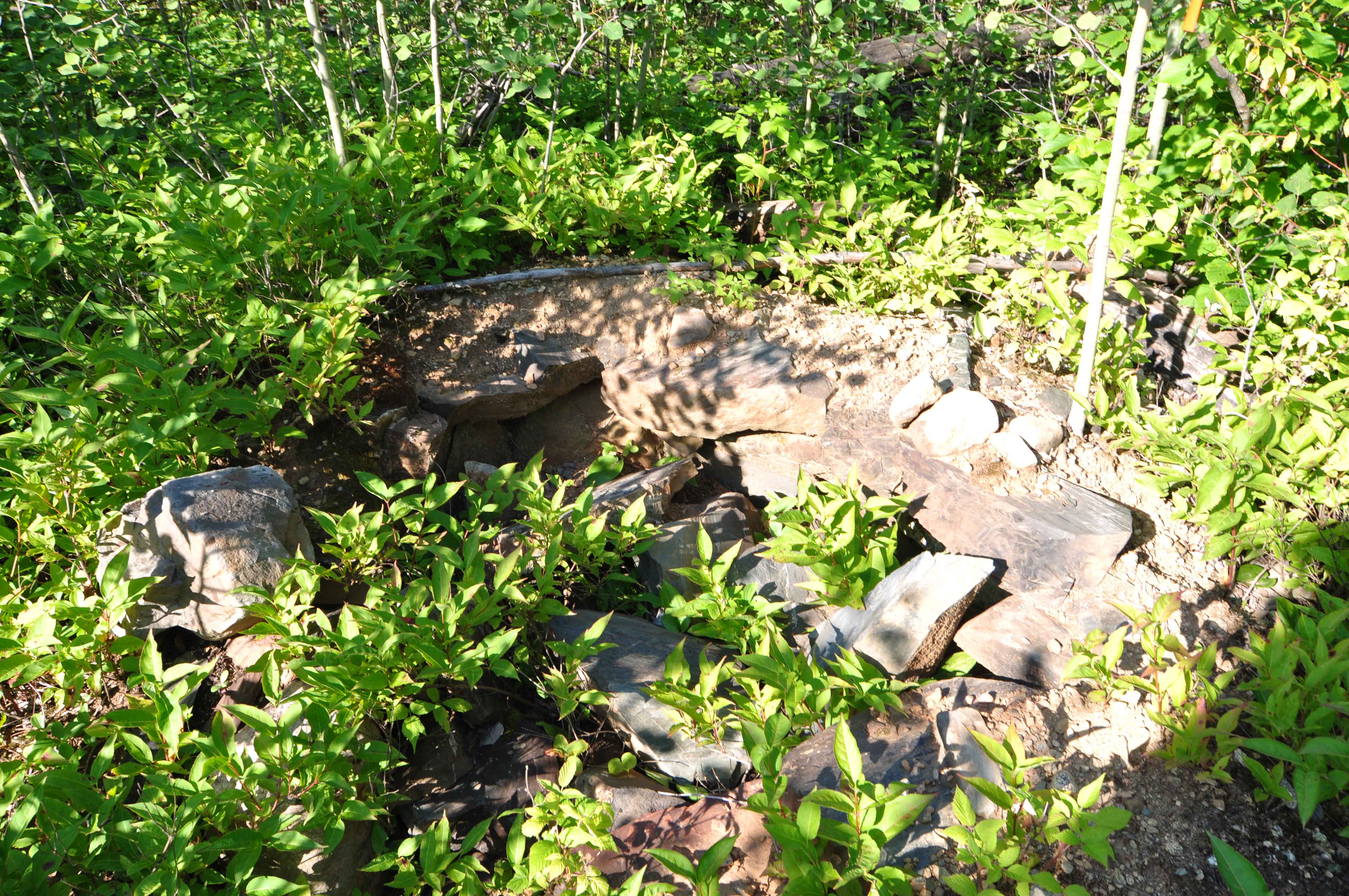
I had brought with me a small shovel to excavate the slabs of rock I could see jutting out of the sand. When I began to dig it became apparent that the nearby brush was going to cause a problem, so I retrieved my K-Bar knife to cut away some of the growth. As I did, I instantly recognized that the oven site was just a foot or so north of where I had started to dig. I quickly cut away what I could, trying to disturb as little as possible of the remains. I could make out a depression where the centre would have been, and then the slabs of rock scattered around. It is impossible to tell if the oven was damaged by the blowdown, or the subsequent logging operations.
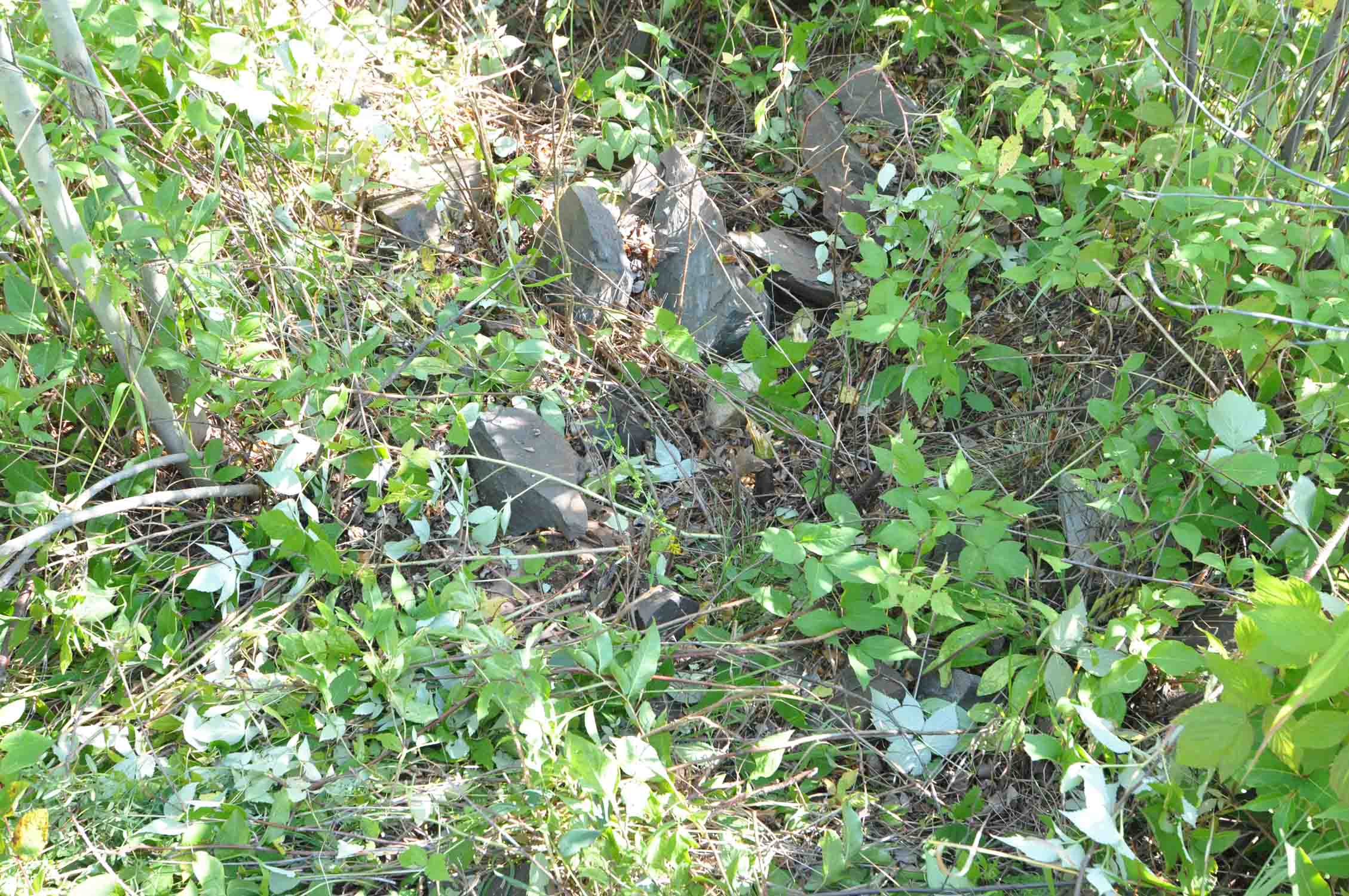
Remains of a rock oven, Leeblain, August 2012.

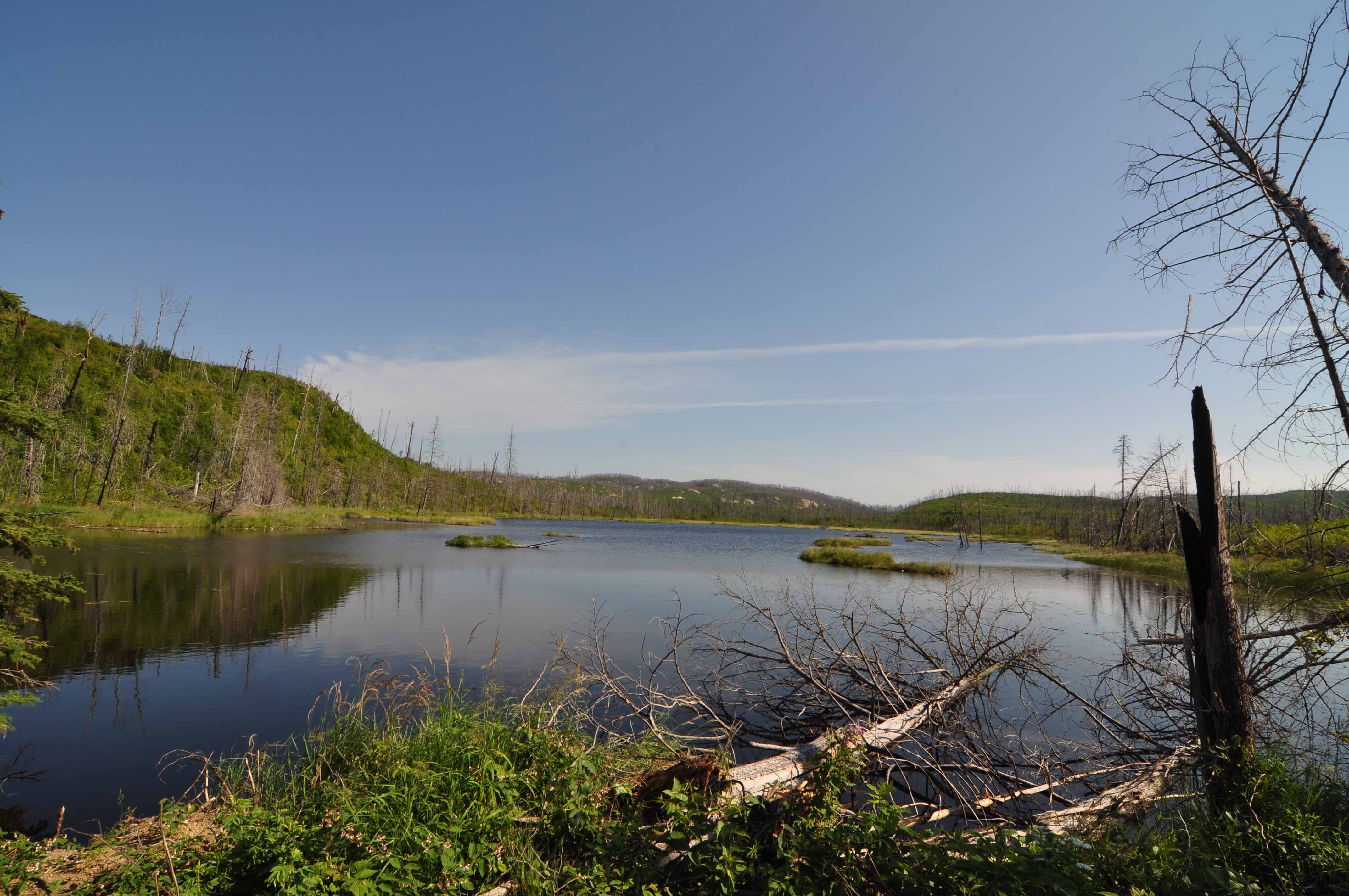
After my great discovery, I decided to take a little stroll along the grade to where some of the development is taking place near the unnamed lake. I’m usually in a hurry every time I hike the railway, so my leisurely pace was a nice change. I spent a lot of time staring at the ground, especially along the sides of the grade where some of the soil had been pushed up. I saw a lot of spikes, but a few other interesting things. I spotted what appears to be a hasp from a trunk or piece of luggage, which I decided to pick up. I also saw a lot of little nails, almost horseshoe size, so I pocketed a couple of those as well.

From Leeblain my journey would take me to the end of the lake at Gunflint Narrows. I decided to beach the boat in Charlie’s Bay (or so I call it), near the property of long time lake resident Charlie Cook. Charlie passed away in 1997 but his cabin had still stood on his land just south of the grade about 800 metres east of the Narrows. At the presentation people had told me that his cabin had been bulldozed and I wanted to see for myself. It was very flat, a wasteful destruction in addition to creating a huge mess. Charlie had lived his whole life on the lake and I assume there might have been some interesting things in that cabin.

Charlie’s Bay, Gunflint Lake, August 2012.

After a short walk, I arrived at the Narrows and proceeded to take a look at where the eastern abutment of the trestle might be. I found it easily enough, but I was shocked at the amount of junk and debris lying around. I guess in days past no one thought of disposing of things properly, and I wouldn’t imagine where you would dispose of garbage around here. I walked down to the lake, but I was not able to see as much as I wanted to since the water level is up from years past. You could see the rock cribs under the water, but the pilings were tough to make out.

Gunflint Narrows, August 2012.

Heading back east, I spent a bit of time poking around the area just north of the grade. In one spot was located the station at the Narrows and in another was the “town” of Gunflint. I wandered around for a while, but I couldn’t see anything substantial. There were people living around that area for quite some after the railway, so it is difficult to determine what objects (cans, metal items) are from when. The new growth has also made it difficult to see what if anything might lie on the ground.

My last agenda item for the day was to venture through the Narrows into Magnetic Lake. Many locals claim that an area about 100 metres north of the Narrows was quarried to create the rock cribs for the trestle. After driving by, it is a certainty that quite a bit of rock was removed from the cliff on the opposite side of the peninsula from the railway. Where that rock ended up can’t be conclusively proven, but it is an interesting theory.

So tomorrow unfortunately marks the last day of this wonderful trip. The boat is on the trailer and ready to roll. I still have a little exploring to do before I leave however, as I have to return to the Minnesota side of the Narrows to take more pictures and video. Then it’s back home to the family. I hate to leave, but I do miss my wife and the boys. I really hope I can get back here next year as there I’d like to explore the Gunflint and Lake Superior Railroad.

Anyway, it will be another busy day soon enough so it’s off to bed soon, but I’ll be back tomorrow with again. Until then…
 
Leave a comment

Posted by on August 7, 2012 in Hiking, Miscellaneous, Research, Travel


Tags: , , , , , , , , , ,

Gunflint Day 2

Well, I’ve had a shower, I’ve eaten, washed the dishes and now it’s time to write. Sort of ironic that as I sit in the great room at the Cross River Lodge and write about my day hiking, I’m watching Owen Wilson run for his life in the movie “Behind Enemy Lines.” It has been a very busy day and I’m quite tired.

I thankfully had a good night’s sleep…I guess going to bed at 9:30 helped too. I slept pretty well until 6:30, and then lounged in bed for another half an hour before I got up. It was a nice morning on the lake, though I did notice that the wind was up which was not a good sign.

Sunrise on Gunflint, August 2012.

After breakfast I started my journey to the east. I was quite concerned about the state of the lake, as I could see whitecaps forming in the open water. Gunflint Lake is a very deep lake, surrounded by high ridges; when it’s windy the lake tends to get very nasty. It was going to be even more challenging since I was by myself, with no one else to help level and trim the boat. As it turns out it, my fears were confirmed and the lake was fairly tough to navigate. I was forced to creep along at half-speed (18kph), constantly watching my position in relation to the waves. So my 8km trip took quite a while!

When I arrived at the east end of the lake, I wanted to avoid some private property along the bay, so I was forced to beach the boat on a rather rocky shore. I had quite the struggle pulling up the boat, in the process smashing it into the side of my left knee. It’s quite swollen now and I’m sure it will be loads of fun tomorrow! Once that was all out of the way, I started walking.

My journey was going to take me just over 4km to the east, back to where I stopped my hike last year. I was immediately greeted by a number of rock cuts and embankments, which would set the tone for the rest of the hike. One of these embankments even had a very interesting culvert built into it. It appeared that they blasted a channel into the rock and the covered it with flat pieces of rock. Crude, but expedient…and it still works!

Rock culvert, Gunflint Lake, August 2012.

From there the grade crosses over what was a high bridge and then enters a wet, low area for 800 metres. Thankfully someone had recently driven along the railway which helped push down some of the new growth that has sprung up since the fire 5 years ago. It was really the only difficult section I had to contend with, and unfortunately kinda boring. Not much to see except chest/head high brush and burned trees!

After this tough stretch, the grade did improve. For the next nearly 2km the railway runs along the shore of the lake, about 100 metres or so from the shore and over 150 feet above it. With the trees gone, it provides an amazing vista of the lake. It was then on to the last major feature before my destination, another bridge crossing. I had visited this location in 1997 before the blowdown and fire, but I had high hopes with the trees gone. The drop to the creek from the grade is over 20 feet, but I wasn’t able to find any remains in the valley. With the rains in May and June the water level is a bit high, frustrating my search.

Gunflint Lake from the railway grade, August 2012.

Two hundred and fifty metres past the bridge I arrived at my turn around point, which was the intersection of the railway and the Gunflint and Lake Superior Railroad. The G&LS was a logging line that was constructed in 1903 and used until 1909. The junction used to be very easy to spot and there was a trail leading down to the lake. Unfortunately it was probably not used after the blowdown and is littered with deadfall and burned trees.

My journey back was smooth, except for the threatening skies. The forecast called for a chance of showers, even thundershowers, and it looked like it was going to happen (it only spat enough to nake the leaves a bit wet). I couldn’t stop at my starting point though, as I had to walk approximately 800 metres west to cover a section along the lake that I did not get to last year. As it turns out, I went 250 metres further than I needed to!

When I got back to the boat, I was shocked to discover, despite placing the cover on it, that the waves had splashed quite a bit of water over the transom. It took me about 15 minutes to bail out the water (gotta get a bilge pump), made worse by my tightening hamstrings. I had walked nearly 11km! Then it was off to creep back to the lodge at half speed, trying to stay pointed into the waves and avoid the reef off the point near Leeblain. I couldn’t believe the canoeists were braving the lake.

The break at the lodge was a brief one; enough time for a quick snack and to prepare my GPS for the next adventure. My host, John, was going to take me to the Narrows to look at the railway there and hunt for an “interesting” treasure.

Our first stop was at the home of one of the local residents; Jerry and Sharon had spoken to their neighbours and had agreed to take us for a look around. I was able to photograph and video the Narrows in the afternoon light as I wanted to. Our search for the mystery item was unsuccessful; we had the general location, but sometimes it’s like the proverbial needle in the haystack. Jerry has agreed to take me back on Wednesday morning so I can get some proper data and more images.

Well, I need to post this blog and turn in. Tomorrow should be a less strenuous day, with a visit to Leeblain and the Ontario side of the Narrows. There will certainly be a lot less walking, which is good since my knee isn’t too happy. Hopefully I’ll return with good news in my search for rock ovens and building remains. The forecast calls for a high of 24C and lighter winds…well see what happens!

Until then…

 
Leave a comment

Posted by on August 6, 2012 in Hiking, Miscellaneous, Research, Travel


Tags: , , , , , , , , ,

Gunflint Day 1

Greetings from Gunflint Lake! I am sitting here in the great room of the Cross River Lodge watching football as I write this. If it weren’t for the pounding headache that I have, life would be awesome. I’ve had a good day for the most part and I am certainly looking forward to tomorrow.

So this week has been a very busy week for me. This is my second kick at some fieldwork in less than a week. On Tuesday I decided to take the boys with me and walk a bit of the railway near the former village of Flint. I mentioned in my previous post the Flint is a village no more since most of the area has been washed away by the Whitefish River.

We started our hike where Diana Road ends along the river and headed north. It was going to be a 3km round trip, which I thought was well within abilities of the boys. It unfortunately was a cool night, so there was a heavy dew which made everything dripping wet. In areas the grass and vegetation growth was much thicker than I expected, but the boys took it in stride (much to my shock) and were real troopers about it.

When we arrived at our destination, which was a crossing of the river west of Harstone, we spent some time examining the remains of the bridge there. We then headed back and checked out some of the eroded sections of the grade. In one area it there was what appeared to be the remains of a diversion of the river. The engineers diverted the river is several places along this stretch of the railway and this could very well have been one of those locations.

When we passed through Flint we made our way down to the river to see what might still be lurking in the area. We could see some of the remains of the bridge across the river but no traces of the former village. From there we crossed the Silver Creek and finished our little adventure.

So that brings us back to Minnesota. I made the drive down to this very beautiful area today to give a talk at the Chik-Wauk Museum on the railway and the Paulson Mine. I’m sticking around for a few days to do some hiking on Gunflint and hopefully Mother Nature cooperates!

After stopping for some supplies in Grand Marais, I arrived at my “home” for the next few days, the Cross River Lodge. I’m staying in the main lodge and my room is amazing. Even as I sit here on the main floor I’m struck by how well appointed this resort is. What is even better is the hospitality of my hosts, John and Rose Schloot. They have been nothing short of fantastic and the staff is equally wonderful!

The presentation today had the makings of an interesting experience since it was outdoors and I had no technology assistance (other than my tablet for my notes). It was well attended (I didn’t count the number of people) but I’d have to guess there were about 50 people. I managed to stay within the one hour time frame and I fielded many questions about the railway and the mine. I’m looking forward to doing it again at some point in the future!

Following the presentation I returned to the lodge for a bite to eat and then headed out for a bit of exploring along the Gunflint Narrows Road. My main goal was to try to locate the turning wye that was situated just north of the crossing of the Cross River. I had spent a bit of time examining the area on Google Earth and I was pretty convinced that I would easily find this unique feature. Unfortunately as I began to walk it became apparent that I would not find it. I crisscrossed the site many times but I could not see any definitive traces. I guess the wye is where we thought it was all along, obliterated by a gravel pit.

Well, I’m heading off to bed since my head is still pounding and I have a long day tomorrow. I will hiking the eastern end of the lake and let’s hope I don’t get rained on. Then my host John will be taking me to the Gunflint Narrows to look at the railway there and maybe even see something neat!

Until tomorrow…

 
Leave a comment

Posted by on August 5, 2012 in Hiking, Miscellaneous, Research, Travel


Tags: , , , , , , , , , , , ,

I could talk for hours!

In case you’re wondering, I can…seriously. If I’m talking about something I’m interested in! One cannot be a history teacher and not like to talk; it’s kinda like being a comedian and not telling jokes. So I literally make a living by talking, a lot. Now don’t get me wrong, I can shut up if I need to, but I rather enjoy the one way conversation. And I do like to take my time with my explanations. When my wife asks me a question, she always finishes her request with the statement “…and in 20 words or less!” Unfortunately I find it very difficult to provide a sufficient description in such a limited context. Brevity is just not my thing; once when I was a kid a friend of the family offered me 25 cents to stop talking!

Anyway, so why the commentary on talking? Well, talking was one of the biggest highlights of my week. As mentioned in my previous post, last Wednesday I delivered my first public lecture on the railway since 1998. Fourteen years…that was certainly a long spell between talks! It was also my only railway related event of the week since I didn’t want to push my luck and go for a hike too. Gotta make time for the family first!

Speaking of which, I did get my share of family time in. We have been spending a fair bit of time at camp (the cottage, the lake…we’ve had this conversation) this year and this past weekend was no exception. I know that my boys enjoy it out there and my wife LOVES the sauna. I can be a bit of a chore though, since it is like having a second home. I spent most of Saturday morning cutting the grass (my fav) and I know that I’ll have to finish the rest when I’m out again. This also means that I haven’t had a lot of time at home, and the grass here has gone a few weeks without a trim. Thankfully it has been pretty dry so the growth has been rather slow.

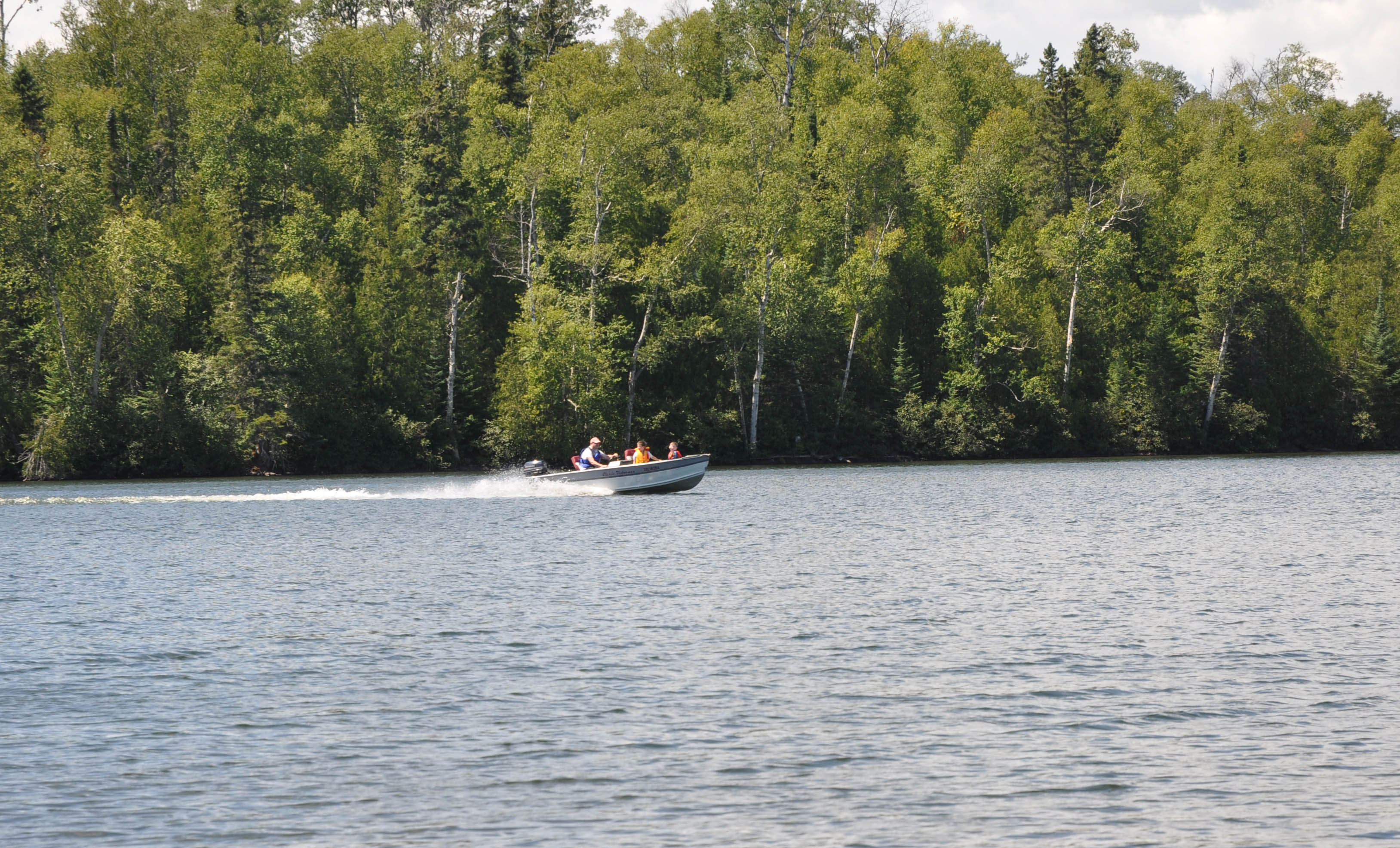
Boating at camp, July 2012.

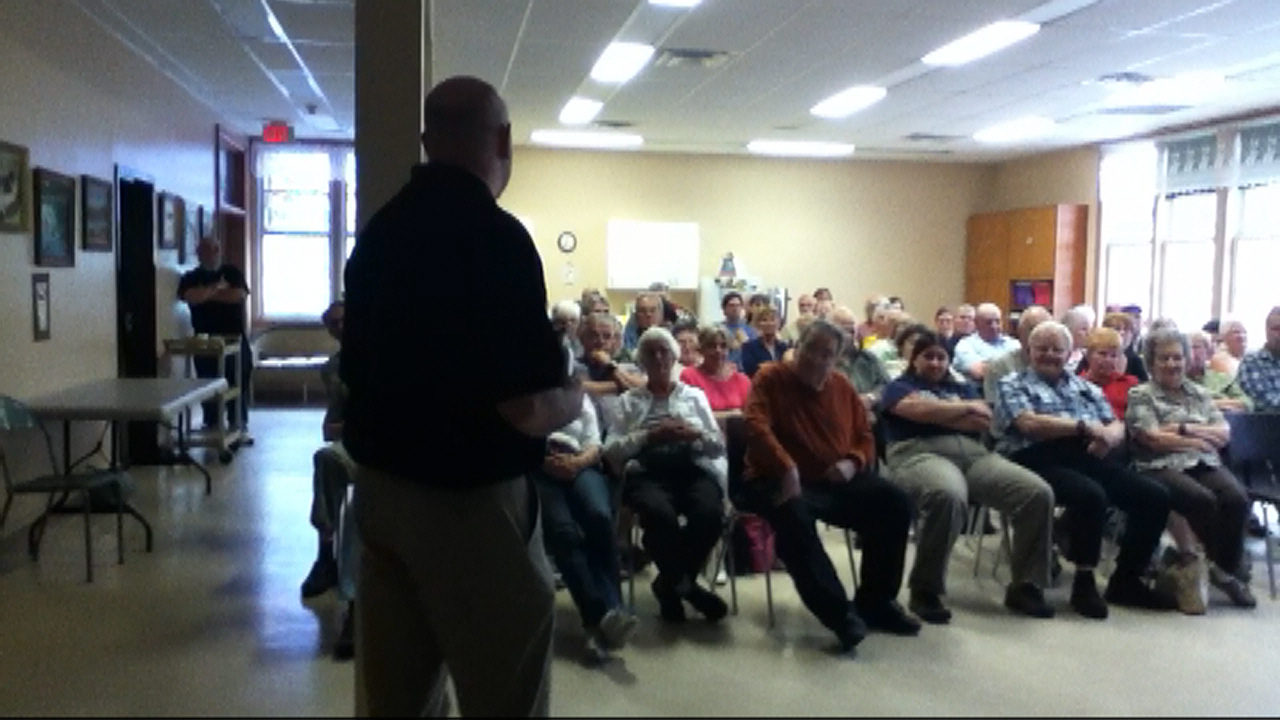
So, the presentation. Well, I can honestly say that it went fairly well. I was a bit nervous; it is very different talking in front of a bunch of adults than a classroom of teenagers. I was also unsure what the turn-out would be like. The last thing you want is to be giving a lecture in front of 5 people. In the end, there were 80+ people in the audience, which is a pretty decent crowd for a Wednesday night. It did feel the pressure at the beginning, but then I settled down into a nice comfort zone. Part of my apprehension stems from the fact that I’m way more knowledgeable with the material in the latter half of the presentation.

Duke Hunt Museum, July 2012.

The only bad part I can say was that I went over time-go figure! I thought I’d talk for about an hour, but I finished after one hour and forty minutes. I like to talk! I did not get any negative feedback and it seemed as though everyone was very attentive through my extra-long rambling. I’ll have to make sure I stay on track for this weekend.

On Sunday I’ll be making my first “international” presentation as I head down to the Chik-Wauk Museum at the end of the Gunflint Trail to give a lecture very similar to one from last week. Obviously the audience will be a bit different, so my emphasis will be more on the Paulson Mine and less on the railway. It is of no consequence to me however, as I feel very confident with both areas.

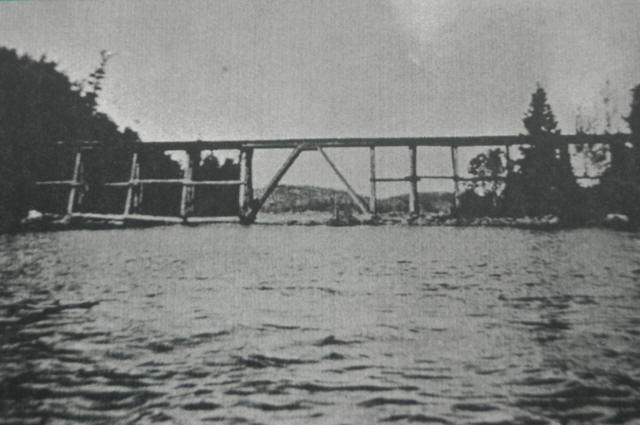
Gunflint Narrows, 1911.

The only weird part of Sunday’s talk as that it will be outdoors, therefore I will not have access to any technology. I spend every day during the school year talking in front of a Smartboard, but I will have no visuals to assist me there. It will be a very strange feeling. I’m sure my power to blab will carry me through…as long as I stay on time.

Following the presentation I plan to spend a few days on Gunflint Lake completing some fieldwork that I started last year, particularly on the eastern end of the lake. I’m also going to spend some time at Leeblain, as well as on both sides of the Gunflint Narrows. Should be a good time if Mother Nature cooperates!

Gunflint Narrows, August 2008.

On the topic on Gunflint Lake, I did receive some interesting news pertaining to the work at Leeblain. My local MPP cc’d me a letter that was sent to the Minister of Tourism, Culture and Sport, which oversees such things as historical preservation and archeology. Hopefully the government takes an interest in protecting the railway and such rare treasures as the rock ovens near Leeblain.

In the last few days I’ve also discovered some very important information related to the railway. Since I began my research 18 years ago, I believed that the railway still owned the right of way. Much of this stemmed from some old documents that I had, and information provided to me by some property owners. After I received the letter, I was then advised that the grade was in fact Crown Land. I did some digging of my own and I came to the same conclusion. The big question that now lingers is has any of the right of way been sold off, or is it all still public land? Hopefully I will find out soon enough.

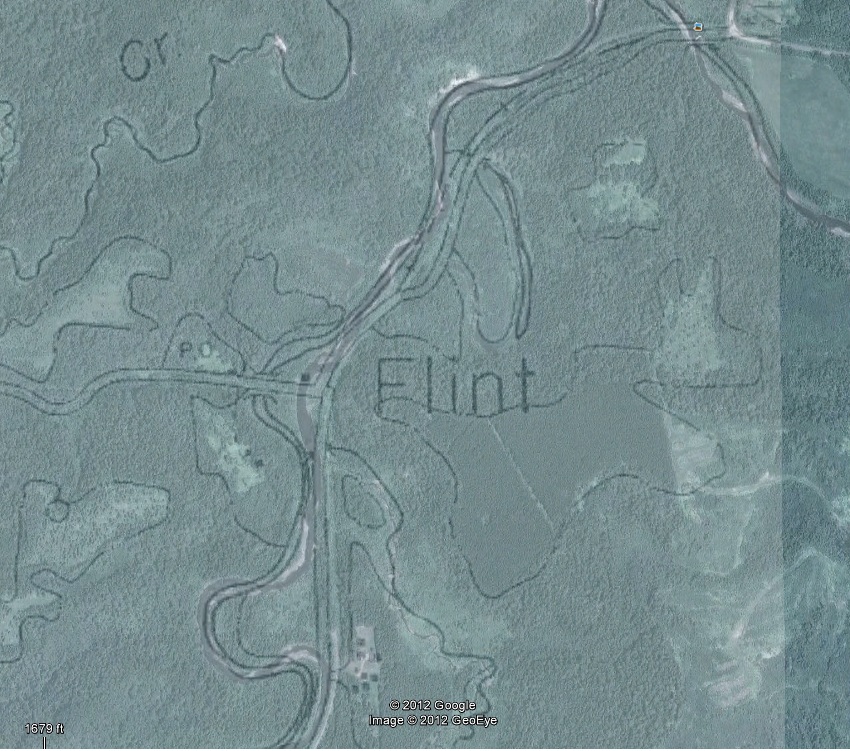
Tomorrow I am heading out for another hike, the last before I head down to Gunflint. It’s going to be a short one, probably only 3k and so I am going to take my boys with me. We will be walking the grade near the old village of Flint which lies between Harstone and Hymers. It is a rather interesting spot since the majority of the land on which Flint sat at one time has now been obliterated by the Whitefish River. As you can see in the rough Google Earth overlay (not everything matches up), the river has shifted some 80+ metres to the east since 1960. I haven’t been there since 1995ish so I’m interested to see what I’ll find. I’ll certainly get some video and I can post it with my flashy new intro. I had a former student of mine create the introduction and so far I’ve uploaded one video with it; makes me look kinda professional!

Flint, ON.

Anyway, gotta get going. My next post will be on Sunday night from the Cross River Lodge (they do have internet) and I’ll try to have some pics of the presentation. Until then…

 
1 Comment

Posted by on July 30, 2012 in Hiking, Miscellaneous, Research, Travel, Writing


Tags: , , , , , , , , , , ,

Back to God’s Country

Catchy title huh? Betcha you thought I had this great enlightening moment when it came to me right? Wrong…I stole it! Back to God’s Country is the title of a of 1919 Canadian silent film which was based on a short story written by James Oliver Curwood (there were remakes in 1927 & 1953). Ironically enough, Curwood wrote several novels with the same theme, one of which, The Country Beyond (1922), specifically mentions the railway in it. Curwood spent a lot of time along the railway dating back to the 1910’s, which influenced his writings. So, why did I pick this as the title for this week’s blog? Well, you’ll just have to keep reading.

So, what’s new? Well, it’s still stinking hot. But it’s summer, what’s so unusual about that? It is unusual because we seldom get this many days of solidly hot weather; it has been close to, or over 30C for the past 10 days. That is very weird for our area. Global warming? Probably, but that doesn’t exist right? Anyway, it has been both a blessing and a burden. I certainly appreciate the warm weather, but at times it has just been hard to bear, especially the humidity. You have to remember that it gets down to -30/-35C in the winter; that’s almost a 60 degree temperature swing!

In the meantime I have been very preoccupied with the visiting relatives I spoke about last week. On Tuesday we travelled down to Grand Marais, Minnesota which is a picturesque little town about 1.5 hours south of here. While I was there I paid a little visit to the folks at WTIP radio since I’ve had several conversations with the news director at the station regarding the railway. They are going to do a few little radio promos for my talk at the Chik-Wauk Museum on August 5th.

I also had a chance to stop by the Cook County Museum and meet up with an old friend, former museum director Pat Zankman. Pat and I met back in 1997 after I had written to the museum looking for information regarding the railway and the Paulson Mine. It had been a long time since we had spoken so it was good to re-connect. Pat has already prepared some writing work for me about John Paulson…I could make this gig a full-time job!

Anyway, the relatives enjoyed the trip and it was nice to beat the heat along Lake Superior. Yesterday we took them back to camp, with a short trip to Ouimet Canyon. Unfortunately it was scorching hot, but I was able to cool off with a nice dip in the lake. Then it was back into the heat for a refreshing sweat in the sauna! The time at camp also gave me time to try out the “new” boat we bought to take the kids around the lake (it obviously is used). Runs very nice…can’t wait to get it on to Gunflint Lake in August!

Well, what about the title Dave? Okay, I guess it’s time to talk railway. So on Thursday I decided to take a journey to the Canadian side of Gunflint, which is a rather interesting ordeal since it involves a 150km drive over some very rough road. The last time (and the first time) I did this drive was in 2008. I had recently heard that sections of the road had been repaired, and more importantly, that some work was being done along that lake near Leeblain. As I mentioned last week, I am very concerned for the preservation of the rock ovens near the ghost town and any potential remains that might be located there.

So my journey began very early, since the drive would be long and I wanted to beat the heat. The trip started with a very unique twist in fact. As I was passing Iron Range Lake and some road work, I noticed a guy walking along the road. It is very unusual to see someone walking along the road in that area since it is very remote, especially since it looked like the guy belonged in a metal band and not walking a gravel road. About 10km or so up the road the story got even better; I see a SUV on its side along the road. Then I realize the guy I saw was the driver of said vehicle (he had probably lost control and rolled), but he made no attempt to flag me down or anything. The plates were from Virginia, and the message written in the dirt on the rear window said “I’m fine, gone up the road.” What a bizarre episode.

Flipped SUV.

Eventually the gravel road became even rougher, and I entered the area burned by the 2007 fire. As I approached Gunflint Lake my thoughts were that people would have to be nuts to drive into the lake on that road on a regular basis-it was insanely rough! However, once I reached the area just above Magnetic Lake, the view was worth the drive. The surrounding ridges sit some 200 feet above the lakes, and a beautiful panorama unfolds before you. It is very breathtaking, even with the burned nature of the forest.

Magnetic Lake, Gunflint Narrows and Gunflint Lake, July 2012.

As I was descending the hills toward the lake, I came across several heavy machines heading north. I stopped and chatted for a while with the driver of a large dump truck. He told me that they were done working and were leaving the area, which was much to my relief. He also informed me that they were aware of the rock ovens and that there were currently no plans to develop that area. I certainly felt a big weight lifted off my shoulders, but I did want to check the ovens over for myself.

The ovens are located approximately 300m northeast of the newly graded road along the railway right of way. I drove to the spot and quickly found the undisturbed oven with my GPS. I decided to take a few minutes and poke around to see if I could locate the other oven that was nearby. To my surprise I may have located it buried in sand that was placed on the grade back in 2000 when the area was logged. I’ll have to go back with a small shovel to investigate further, but it appears it is in the right spot.

Rock oven, Leeblain ON, July 2012.

I then drove a little further up the road to where the RV sites had been created and near where the grade crosses a small creek emptying from an unnamed lake. From there it would be nearly 4km to our destination at the Gunflint Narrows. Almost immediately it was obvious that some work had been done to the grade, as the workers had replaced a burned bridge over the creek with a culvert and had bulldozed the right of way. They did muck some stuff up (ie. disturbing some of the drainage) but they also turned up things that had been buried like dozens of spikes.

Unamed Lake, July 2012.

After the small lake, the railway passed through a number of small rock cuts before the grade and the road split. When the area was logged in 2000, they chose not to follow a 600m section of the grade and instead built a new road around it. About 300m is through a swampy area, and the remainder encompasses an embankment and a rock cut. The road then intersects the grade, and afterwards there are several long embankments (they are not particularly high, but made of a lot of crushed rock). The second embankment is followed by a 150m long, 20 foot high rock cut.

This cut is of particular importance since it is the location of the Gunflint Cross. I made mention of the cross in a previous post and although this was my third visit to the site, it is still interesting nonetheless. The cross is a memorial to a worker named Joseph Montegia who was killed in a blasting accident near the spot in October 1892. In his memory, his fellow workers carved the cross near where he fell, and today it remains there 120 years later. The cross sits almost 5 feet above the grade, and is easy to miss if you do not know where to look (it was actually obscured by bushes growing at the sides of the cut).

Gunflint Cross, July 2012.

From the cross, the railway passes through several more rock cuts before it reaches the site of a 250+ foot trestle. Most of the eastern side has been obliterated when they created first the snowmobile trail and later the logging road. The trestle sat probably 30-40 feet above the valley, and it is neat to see the remains of the western abutment, with the massive amounts of rock fill that was used. Beyond that there are a few more rock cuts and embankments before the railway reaches Gunflint Narrows. I didn’t walk all the way to the Narrows since I will be returning in August and I knew that it was nearly noon and getting hotter by the minute (the temperature peaked at 36C with the humidity). Poor Loki was feeling the heat!

So I guess I didn’t explain the title did I? Well, this area is so beautiful and remote it is like the God’s country that Curwood spoke of, and it wasn’t my first trip there. As I walked the grade, I did what I often do in the quiet silence; I imagine what it would have looked like all those years ago. It would have been something to ride the train through that remarkable and untouched wilderness. Maybe someday they’ll invent a time machine that will let me do that…maybe in a hot tub!

Anyway, enough for this week…I’m had back to camp today so I have to get going. I’ll be back next week at the usual time. Until then…

 
1 Comment

Posted by on July 16, 2012 in Hiking, Miscellaneous, Research, Travel, Writing


Tags: , , , , , , , , , , ,

Where did spring go?

Today the temperature sits at -4C and there is snow on the ground; it seems as if Mother Nature cannot make up her mind. This is a far cry from the nearly 20C temperatures we were enjoying three weeks ago. I’m sure it will sort itself out soon enough, I hope.

Anyway, a week ago I was standing in the pouring rain at Vimy Ridge; it’s hard to believe a week has already passed. It is good to be home and I’ve finally recovered from the jet lag. It was kinda touch and go there…I nearly fell asleep in class a few times on Wednesday. The pictures have all been downloaded from my camera, all 1316 images or nearly 6gb worth. Wow, I am shutter happy! All video I took is now on my computer too, 24gb of HD content. I was down to the last 10 minutes of recording time on the camera, so that 24gb is about 3 hours of video. I haven’t had time to sort through it all, but I did upload a few highlights to YouTube (From Ypres and Vimy). You can see them by clicking on the following links: Menin Gate CeremonyVimy Song by Lizzy HoytVimy Ceremony Last Post.

In front of the Eiffel Tower, April 2012.

I can honestly day that it was one of the best trips I’ve ever been on, and certainly one of the most special. I’ve already spoken to my classes about it, but I cannot wait to share

more of my experiences and photographs with them. We are already planning ahead to Vimy 2017 and are really hoping that there are similar tours that will be organized by EF. Now having experienced a student tour for the first time, I know what to expect and how to better prepare. Not that I wasn’t ready, I didn’t lose anyone, but there’s always those little things that you cannot anticipate unless you’ve actually done it.

So needless to say I did not get any railway related work done in the last week. I spent my time getting caught

up on all the things I left behind while I was gone and making YouTube videos. I’m sure I will make some time this week to get back to my other life. I still have a few tweaks left to do on the MN History article and then maybe I’ll starting on the Leeblain article for the Thunder Bay Historical Society.

If the weather cooperates, I’m hoping to get into some hiking soon. If the snow goes away this weekend, I’ll try and get out next weekend. I still need to get back to Rosslyn and the few remaining pieces of railway and shoot some video. With those rails obscured by the brush, it’s best to get at them now before everything leafs out and they are even harder to see. It will be May in a few weeks and that marks the beginning of hiking season. I know that it will be a busy spring and summer, but I am going to try and get out as much as I can.

Anyway, I must run. I’ll leave you with one of my favourite pics from the trip. Until then…

Cloth Hall in Ypres, Belgium April, 2012.

 
2 Comments

Posted by on April 17, 2012 in Miscellaneous, Research, Travel, Writing


Tags: , , , , , , , ,

Vimy Day Eight

Well, we’ve started the journey home. I am sitting here at Charles de Gaulle airport waiting for our flight to Toronto listening to some classic rock. Our wake up call was at 4:00 today…thank God this is the last early morning we have. That obviously means though that our trip is over. The past 7 days have been a whirlwind of events, but it was such an awesome experience.

The streets of Paris were amazing, filled with great European culture and architecture. I wish there was more time to explore and take pictures. Two days are not enough in such a great city, but we were on a schedule. I never did see the inside of the Notre Dame Basilica, but the cathedral in Rouen was very impressive as well. I must get back someday, maybe with the family.

Having this time before our flight gives me some time to reflect on the past week, especially on our visits to the battlefields. I think that this was tremendous trip for the students that they won’t soon forget. I am glad that I decided to lead this journey/pilgrimage to France. It took me away from my family for a week, so I too had to sacrifice. However what I gave up pales in comparison to the blood several generations of young Canadians spilled for their country.

We’re in the air now; in the beauty above the clouds my reflection continues. It’s funny how you always think of things after the fact, like how I am right now remembering a few things that occurred yesterday that did not make it into my blog. The one I want to mention was probably the most poignant, which took place during our silent march from Givenchy to Vimy. As our group passed by the Vimy Memorial, we were jolted by a sudden gust of wind from our right. It was almost as if some force was trying to direct our attention to the left, towards the memorial. I’m not sure if everyone else was struck by this occurrence, but it certainly had me looking to the heavens. Someone wanted us to remember.

Now my thoughts drift to our first visit to a Canadian war cemetery, the one at Dieppe. Since the bodies were originally buried by the Germans, the headstones are laid out in German style, back to back and close together. Probably because of the close internment of the dead and because it was our first, the visit was so moving. We had a lot more time to spend there, so you really had a chance to read the names and inscriptions. I won’t soon forget how overcome I was.

After some lunch and a much-needed nap, I am a bit more refreshed. While I was dozing, I thought of our visit to Juno Beach. It was another occasion that needed way more time to fully absorb and explore, but we did our best. I was glad that we got to Bernieres sur Mer where the Queen’s Own Rifles landed at Nan White Sector. Seeing that bunker that I’d taught my students about so many times and walking those blood stained beaches was amazing. The bag of sand I brought home is not some sand from a French beach; it is a piece of Canadian history, purchased with the blood of our youth.

On the last leg now after a hectic connection stop in Toronto. It will feel good to be at home; I know my wife and boys will be waiting for me at the airport. I am excited to see them as this is the longest I’ve ever been away from them. Maybe my homecoming is part of this journey. We get to go home while there are those who never got that opportunity. I should mention this to the kids, that our ability to go back to our families and loved ones is part of their sacrifice. We definitely take our freedom for granted.

Well, I need to wrap things up as I’ve been awake for the better part of 24 hours. I need to get some sleep as I am back to work tomorrow…with a new perspective on what I teach. I will definitely have some great stories for the kids. I know I will enjoy relating my experiences to them and hopefully this has made me a better teacher. And hopefully it will teach them the importance of remembrance. I will end today with one of my favourite poems from the war, written by A.E. Housman. I will be back in a week after a much needed break. Until then…

HERE DEAD WE LIE

Cross of Sacrifice, Bretteville sur Laize Canadian Cemetery.

Here dead we lie
Because we did not choose
To live and shame the land
From which we sprung.

Life, to be sure,
Is nothing much to lose,
 

But young men think it is,
And we were young.


2 Comments

Posted by on April 10, 2012 in Miscellaneous, Travel, Writing


Tags: , , , , , , ,

Vimy Day Seven

Five a.m. wake up call…3 hours of sleep…should be epic! Wow am I tired. This is going to be a long day, but it will be an awesome experience. This will be a once in a lifetime event for students and teachers alike. We will be at Vimy in a few hours, so I need to sleep a bit.

It is six o’clock p.m. and we are finally in the bus. I have been a soldier and I am a teacher; I have prepared for and taught about war. For the first time in my life I understand what it means to be a soldier. Standing in the shadow of Canada’s greatest military monument in the pouring rain and wind, I went to school. It is amazing how it takes a journey across the ocean to fully comprehend what sacrifice really means. I’ve always remembered…now I know I’ll never forget.

This was one of the greatest events I’ve ever experienced in my life. When we arrived at Vimy we went through quite the process. We had to be issued special Vimy medals, arm bands and meal tickets. From there it was into a large building to receive candles and our lunches. We then marshalled for a 2.5km parade from Givenchy to the Vimy Memorial.

As the parade time neared, the gavity of what we were going to be part of started to sink in. As our march began, it was something to behold. I’ve never been part of anything like it. Picture thousands of high students and teachers walking in total silence along a route that Canadians fought on nearly a century before. What really struck me was how reverent and respectful the students were…I couldn’t have been any prouder than them.

The walk also epitomized what Vimy Ridge was all about; Canadians together as a nation. The students and teachers of St. Patrick and St. Ignatius Thunder Bay, and Ridley College St. Catherines walking side by side with a high school from Newfoundland. Just as all 4 Canadian Divisions fought together that day, we marched in solidarity as Canadians wherever we were from.

It was fantastic to witness the reaction of the French people, who lined the streets smiling, waving and holding Canadian flags. They understood so well what is this event was all about; I was so proud to be a Canadian and a teacher. I would put this march near the top of all the trip moments.

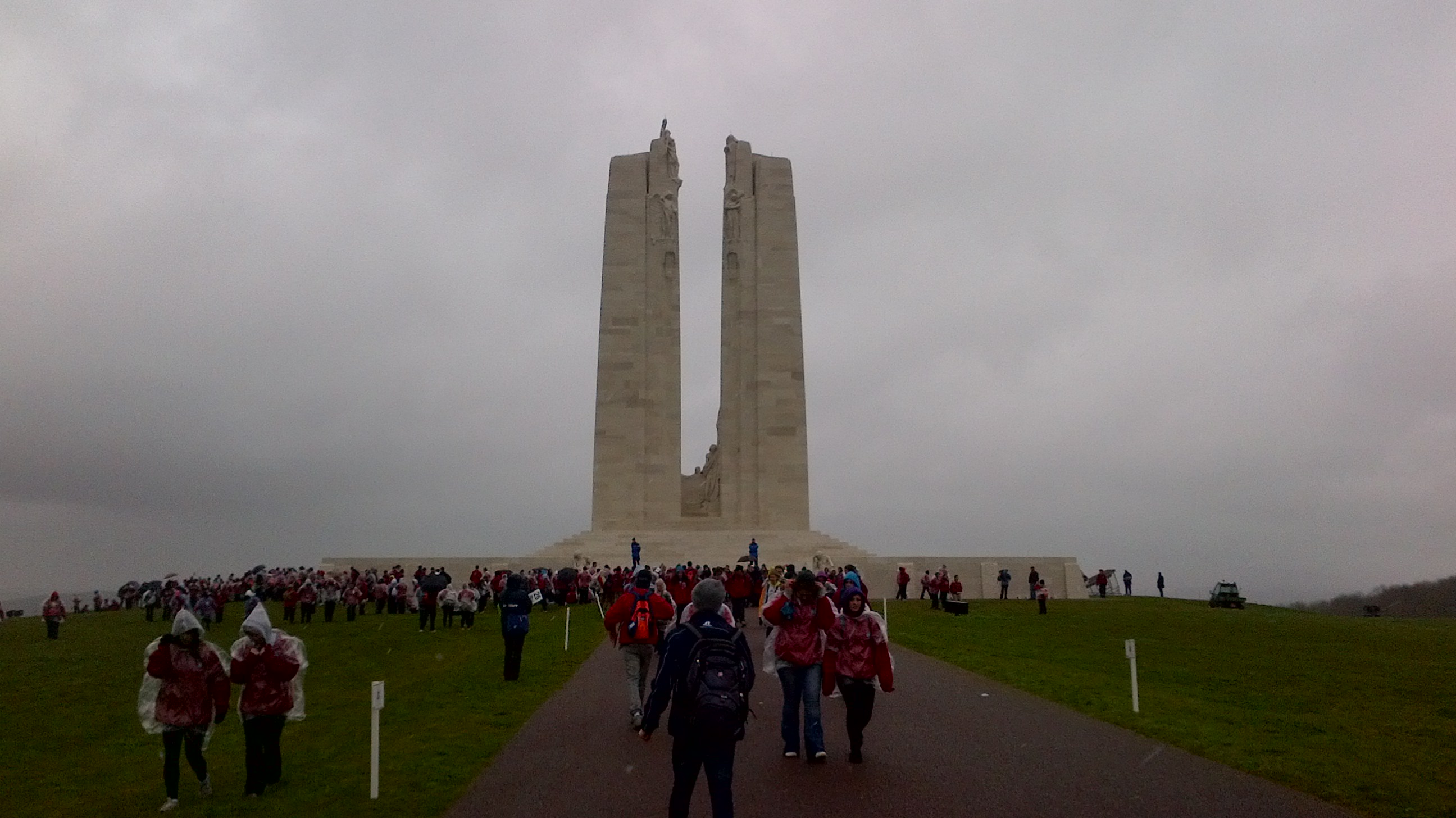
Vimy Ridge National Memorial

When we crested the ridge and saw the wide Douai Plain stretch before us, you really understood why the ridge was so important. Even though it was overcast, the panorama was spectacular. It was then that we saw the memorial up close for the first time. It was a sight to behold and more breathtaking than I ever imagined. We had arrived.


We then moved past the memorial towards Vimy Canadian Cemetery Number 2 for a special EF Tours service. Our route took us past the preserved battlefield of the park, pockmarked with an unbroken sea of shell craters. The fences and signs warning of unexplored ordnance made it so real. The story of the park states that there are 60,000 trees on the site, one for every Canadian killed in the war.

The service was nice, as they lined up everyone in front of a grave. There were readings by students and the playing of the Last Post and Reveille. From there we proceeded to the memorial for pictures and a visit. The only unfortunate part was that we were pressed for time and we couldn’t spend a lot of time looking around. We did get some group photos with the memorial and were able to get on the monument to look around for a bit (they kicked everyone off to prepare for the VIP’s).

I really wanted to get some photos of Mother Canada or the Spirit of Canada weeping for her fallen sons. It is the heart of the monument and sits right in the middle, by herself looking over the Douai Plain. What a moving sculpture…it would have been nice just to have some quiet time there and reflect. We then had to hustle to eat a quick bite before we were off again.

One of the biggest attractions at the park are the preserved trenches. When the park was being created, veterans help to reconstruct part of the trenches along what was called the “Crater Line.” Both sides dug underground shafts in the soft chalk and tried to blow up the other’s trenches. It left massive craters all along the ridge. This area shows the German trenches on one side of a crater while the Canadian trenches are on the other side 50 feet away. The veterans filled sandbags with cement to create the walls, which gives it a very authentic look. Near the Canadian trench is the entrance to the Grange Subway, which was an underground tunnel that led from the trenches to the rear areas. Too bad it was closed because of the volume of traffic.

The next event on the agenda was a ceremony at the monument with all 4000+ students attended by the Governor General, His Excellency David Johnston. We did a lot of waiting and the weather turned very nasty; I Tweeted that it was almost as if the heavens were weeping for Canada’s fallen too. The rain was pouring down and coming in at times sideways. Last night’s honour guard was there again, along with the 22é Regiment band, this time in full dress with Bearskin hats and red tunics. There were speeches, along with a beautiful song by an Alberta woman whose name escapes me now. Then there was the Last Post, Reveille and the Lament. For a while I forgot how cold, tired and sore I was. When I have time, I will post clips to YouTube.

After the ceremony we headed back to the bus; we were supposed to go to a concert a nearby stadium next. However, given the fact that everyone was drenched and exhausted, we decided to forgo the concert in favor of returning to the hotel. We would have liked to have stayed, but because of early flight, we would have to have left by 9:00 for the bus ride to the hotel. Everyone managed to get in a shower and then head off to get some food.

Since I’m up in 5 hours, I’ll sign off. Until then…

The Spirit of Canada (Mother Canada)

 
2 Comments

Posted by on April 9, 2012 in Miscellaneous, Travel, Writing


Tags: , , , , ,

Vimy Day Six

Happy Easter! This is the first time I’ve spent a major holiday away from home, so I’m really missing my wife and kids. I’m sure they went to mass in the morning and then enjoyed the goodies the Easter bunny brought.

Right now we’re on our way to the Nine Elms Cemetery in Thelus for our cemetery visit. Each student was assigned a soldier to research at a specific cemetery as part of the tour. Should be an interesting event. 

While I have a moment, I thought I would comment on the experience of eating breakfast in France. I normally eat a bowl of cereal in the morning, so this is quite novel for me. Breakfast has been buffet style, with the usual fair of cereal, fruit and yogurt. What is interesting is all of the cheeses, meats and various breads available. Not a good meal if you’re watching your carbs!

After a two hour drive, we arrived at the Nine Elms Cemetery (which is about a 10 minute walk from the Arras Road Cemetery where we parked). It is a pretty little cemetery right beside the highway. Before we visited the graves we held a small service by the cross of remembrance to pay tribute to those that fell. 

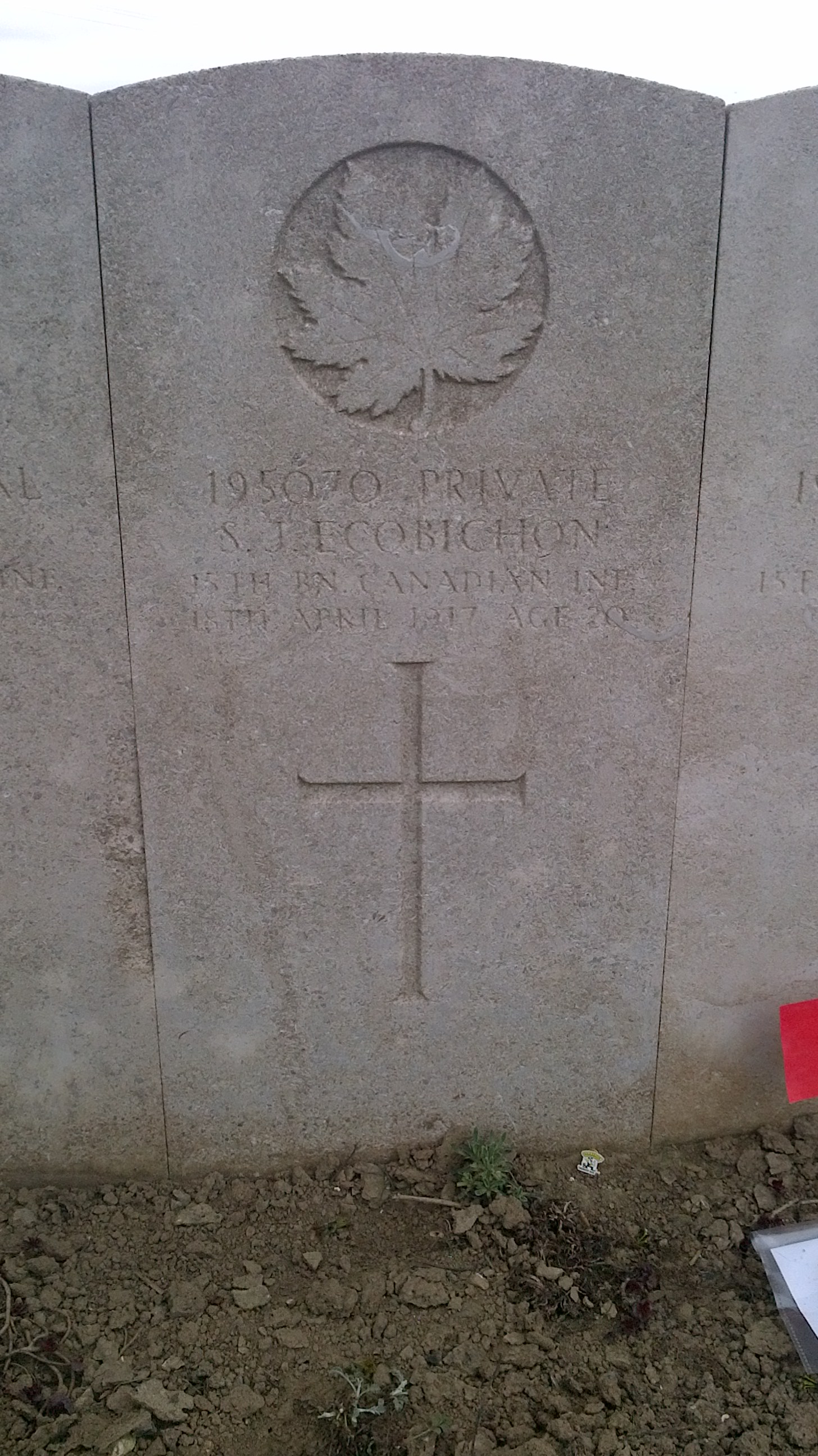
Grave of Private Ecobichon, 15th Battalion, CEF.

We were given enough soldiers that I also had one to research. Sidney Ecobichon was born on Jersey in the Channel Islands in 1897. He lived with his parents in Peterborough before enlisting and being assigned to the 15th Battalion. Ecobichon was killed in action on April 18, 1917. I believe he was originally buried in the Arras Road Cemetery, but was transfer to Nine Elms and rests in an area called the Arras Road Memorial.


While we waited for the bus, I decided to look in the adjacent farmers field to see if I could find anything. Almost instantly I found a shrapnel ball; very quickly I was joined by several other treasure seekers. It was the most excited I’d seen the kids! We turned up many more shrapnel balls, bits of metal, a German cartridge and I found the base of an artillery shell. Sadly we had to retire to the bus! 

An hour drive later we arrived at the Tyne Cot Commonwealth Cemetery near Ypres, Belgium (or Ieper). It holds 30,000 burials! The size of this cemetery is just staggering…it almost beyond comprehension. The headstones stretch on and on. It really gives you an idea of how massive the loss of life was during World War One.

On the ride to the cemetery my fellow chaperones Riley, Kerry and I decided that we would do

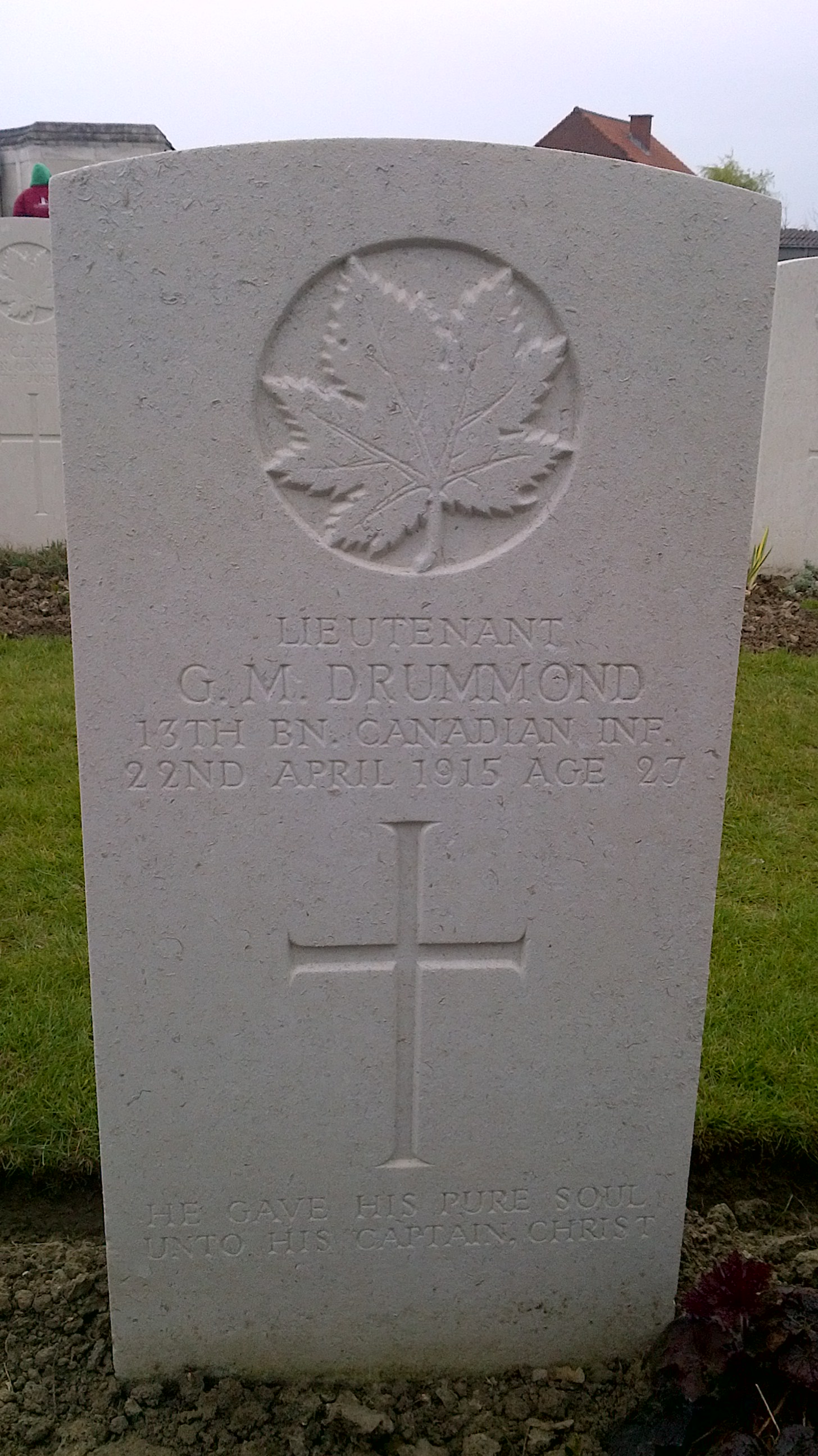
Grave of Lieutenant Drummond, 13th Battalion, CEF.

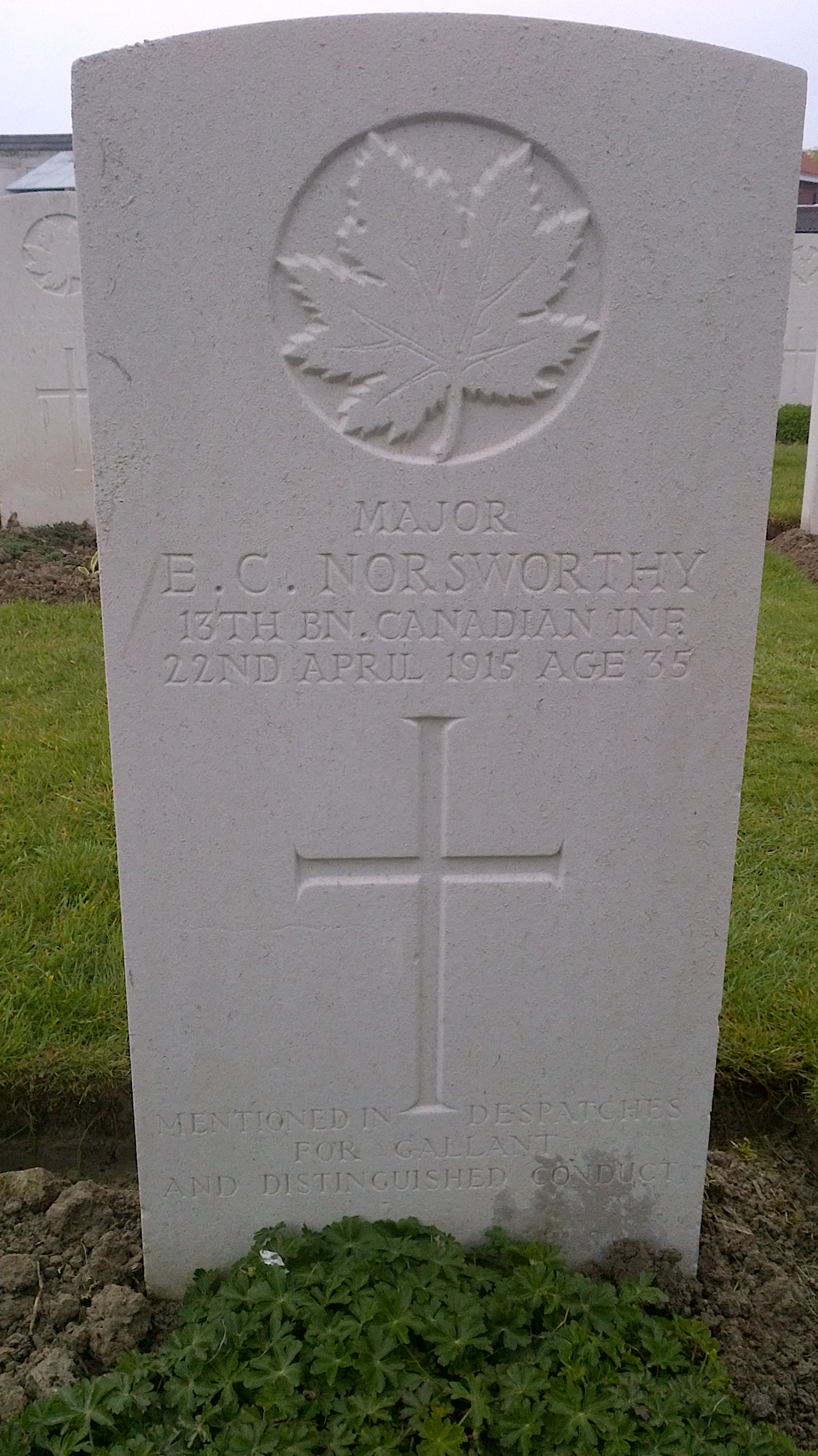
a little investigation. We wanted to look up some Canadians who were buried there. Our collective brainstorming recalled that two prominent Canadians we interred there, Drummond and Norsworthy. Lieutenant Guy Drummond and Major Edward Norsworthy were both members of the 13th Battalion, the Black Watch. They were both killed on April 22, 1915 at the Second Battle of Ypres when the Germans first used chlorine gas. The gas devastated the Algerian troops beside the Canadians, and both officers realized that their entire left flank and the road to Ypres was wide open. They charged into the gap with members of the Watch and surviving Algerians; they were killed holding the line.


Grave of Major Norsworthy, 13th Battalion, CEF.

Supper was in Ypres, at a place called Gasthof Zweerd. There were many other Vimy travellers there, and the square was a sea of black and red jackets. For the first time I left a restaurant full, after our meal of meat salad? and chicken/sausage pastry with fries. We then had a bit of free time, so I headed across the square to buy my wife Jo-Anne some Belgian chocolates. I know she’d rather have something from Tiffany’s but, I did my best.


As I walked around, I noticed a sign with the name of the Governor General on it. I then noticed a large Canadian military presence in the square…something was up. Soon a military honour guard assembled, made up of what seemed like infantry reserve members from many units (including the LSSR). I had to leave as we had to head to the Menin Gate for the Last Post…in retrospect I wish I had left earlier. The area around the Gate, which is a Commonwealth Memorial was already filling with people. The Menin Gate is inscribed with the names of nearly 55,000 men who are missing around Ypres, more than 6,000 of whom are Canadian.

Since 1928 they have held a Last Post ceremony everyday at 8:00 at the Gate (with the exception of WWII). The Governor General, His Excellency David Johnston arrived at the Gate preceded by the band of the Royal 22é Regiment and the honour guard. The ceremony was one of the most amazing things I’ve ever witnessed, well other than my wedding and the birth of my children. I spent the entire time taping the ceremony; when I have time I’ll make a highlight video and post it to YouTube.

Anyway, I have to get rolling since tomorrow we have to get up at 5:00 and it will be a very busy day. I will leave you with another poignant photo…the age of this young boy from Newfoundland will shock you. Until then…

Grave of Private Barter, RNR.

 
1 Comment

Posted by on April 8, 2012 in Miscellaneous, Travel, Writing


Tags: , , , , , , , ,

Vimy Day Five

7:53, on the bus and ready to roll.

I didn’t think I could any more tired, but I am! I had some girls from another school in the room beside me playing music past 12:30 this morning. I was up at 6:00, so my eyes are rather heavy. I’m sure I’ll perk up at Juno Beach and the cemeteries we visit; should be another amazing and emotional day.

The graves of the Branton brothers.

Our first stop today was the Canadian War Cemetery at Beny sur Mer. There are over 2000 Canadians buried there and it was a very emotional experience again. I find it interesting that Beny, like Dieppe, is tucked away in a very quiet location. It is probably better that way. Unlike Dieppe, I did have a mission today, which was to find the graves of Gordon and Ronald Branton. Brothers from Lethbridge, Alberta, they are just one of several sets of brothers buried in Beny. Their inscription reads, “We left with a jest our home in the west. Now here with the best we lie at rest.”


A very short drive later we arrived at the Juno Beach Centre, which was built almost 10 years ago as a museum not only for D-Day, but for all of Canada’s WWII involvement. The Centre was interesting to see, but I really wanted to get to the beaches. The part of Juno Beach in front of the Centre was known as Mike Red sector, and it was where the Winnipeg Rifles came ashore. There was an observation post located just behind the beach, but our Tour Director Hugo was going to take us farther east where there was more to see.

It was very fitting that today was cold, misty and windy, much like it was on June 6, 1944.

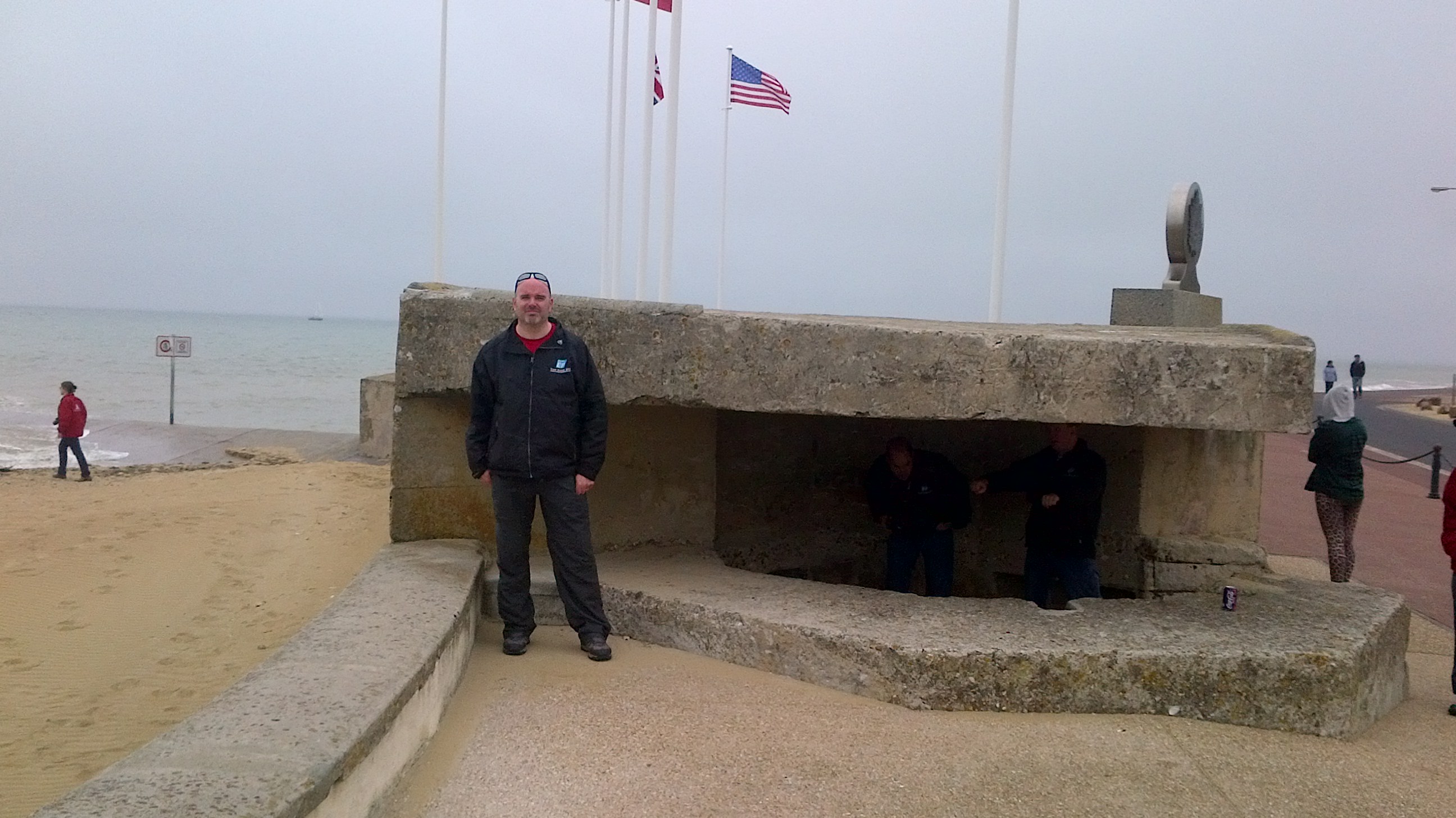
German bunker, Nan White Sector, Juno Beach.

Our next destination was Bernieres-sur-Mer, where the  Queen’s Own Rifles came ashore at sector Nan White. The first house they captured is called Canada House and just down the beach is a preserved bunker adorned with the QOR logo. The Queen’s Own suffered the highest casualties of all the assault units, and looking from the bunker tells you why. Designed to enfilade the beach, it and others killed and wounded half of the QOR in minutes. I made a point of picking up some sand and rocks…almost like I’m taking pieces of Canadian history.


We spent our lunch in the town of Arromaches, which is in the Gold Beach area. After eating a baguette with jambon and frites, I wandered the immediate area for a while. There is a museum there, along with several vehicle and artillery displays. In the sea off Arromaches you can see the remains of the Mulberry artifical harbour system. I think the kids were more excited about the gift shops that sold WWII relics, like shrapnel and shell casings.

On our way back to Rouen, we made a detour to the Canadian cemetery at Bretteville sur Laize. It was quite the adventure getting there, driving all the back roads from Arromaches to Cintheaux. At one point we had to cross a two bridges right by each other with a wicked curve in the middle. Our driver had to get out and size things up; he figured we could make it. After a few tense moments, some skillful driving and a little scrape, we made it through. It earned him a well-deserved round of applause. 

The cemetery at Bretteville has almost 2800 burials and is absolutely huge. It was too bad we were pressed for time as the 30 minutes we had was way to short, but I really wanted to visit this cemetery and was glad that we made it. Our first order of business was to hold a short service in honour of those who gave their lives for Canada. Kudos goes out to our friends at St. Ignatius for organizing these little ceremonies…I think it makes it that much more significant for the students. 

Grave of Major Griffin, Black Watch.

For many years I have taught my Gr. 10 students about the fighting in Normandy, and in particular the Battle of Verrières Ridge . This battle was part of a larger, unsuccessful series of attacks called Operation Spring. More than 800 Canadians were killed in Spring, and they are all buried at Bretteville. In particular, I teach them about what happened to the Black Watch (Royal Highland Regiment of Canada) at Verrieres and how the entire regiment was wiped out. The commander of the Black Watch (who was an acting commander after everyone above him became casualties), Major Phil Griffin, was blamed for the failure of the attack; I wanted to pay my respects to him.I think that it will mean more to me now that I’ve visited his grave and saw the area that was fought over.


There was one more thing I had to do before we left. Prior to becoming a teacher, my career goal was to attend military college and enter the army. When I was 17 I

Grave of Major Styffe, Lake Superior Regiment.

joined the local infantry reserve unit, the Lake Superior Scottish Regiment. The LSSR perpetuates the Lake Superior Regiment, which fought in Normandy as part of the 4th Armoured Division. Forty-two members of the LSR are buried at Bretteville and I thought it was my duty to try and honour them. However due to our time constraints, I was only able to visit the grave of Major Edward Styffe, who was killed in action August 14, 1944. I did pledge to myself that I would return some day and do the fallen members of the Regiment proud.


On our return to Rouen we went to dinner, which was an okay meal of pasta with chicken in a sort of Alfredo sauce. We did take some time to celebrate the birthdays of Matt J. and Cassie who were both turning 16 during the trip. After dinner we had a bit of free time, so the kids could relax, look around the square a bit and unwind. Tomorrow is Easter, so we are heading off to mass at 9:30; I’ve never been to church in another country so I am looking forward to the experience. I’ll finish this off after we return.

The church was locked, so I guess there wasn’t mass. Can you cancel church?

Tonight I had the chance to speak to my wife Jo-Anne and the boys for a bit. Although I am enjoying myself immensely, I do miss them very much. I really want to take my boys here one day to see this for themselves…I think it is something that all Canadians should do. It really makes you thankful for the life we enjoy. After to speaking to my boys tonight and experiencing all the history over the last few days I wanted to leave you with this. I thought it would be a fitting way to end given the purpose of this trip. It was pointed out to me by my colleague Sara at Bretteville. Please click on the photo and read the inscription at the bottom; I became so choked up I had trouble taking the picture. Until then…

Grave of Rifleman Janson, Regina Rifles.

 
4 Comments

Posted by on April 7, 2012 in Miscellaneous, Travel, Writing


Tags: , , , , , , , , ,