RSS

Tag Archives: outdoors

Man it’s hot!

So this morning when I woke up, I was startled by what I saw on the thermometer; the number staring back at me was 25C. I had to take a second look and couldn’t believe what I was seeing. No wonder I had a terrible sleep! That is a very unusual temperature for this time of the year, especially given that the projected low on Wednesday morning is supposed to be 4C. I guess I shouldn’t complain though, since on more than one occasion I’ve bemoaned the cold weather we often get here.

The only unfortunate part of this whole scenario is that these warm temperatures have a very adverse effect on my workplace. Though it has seen many additions over the years, the oldest part of our school is more than 70 years old. The ventilation isn’t that great and our climate doesn’t warrant the installation of air conditioning. That all equals a very (very) stuffy classroom! By 1 o’clock the sweat was rolling down my forehead as I attempted to finish my lesson for that period. Thankfully there are only eight teachings days left before exams, so hopefully I won’t succumb to heat exhaustion before then.

On the railway front, things have been progressing in fits and starts as usual.
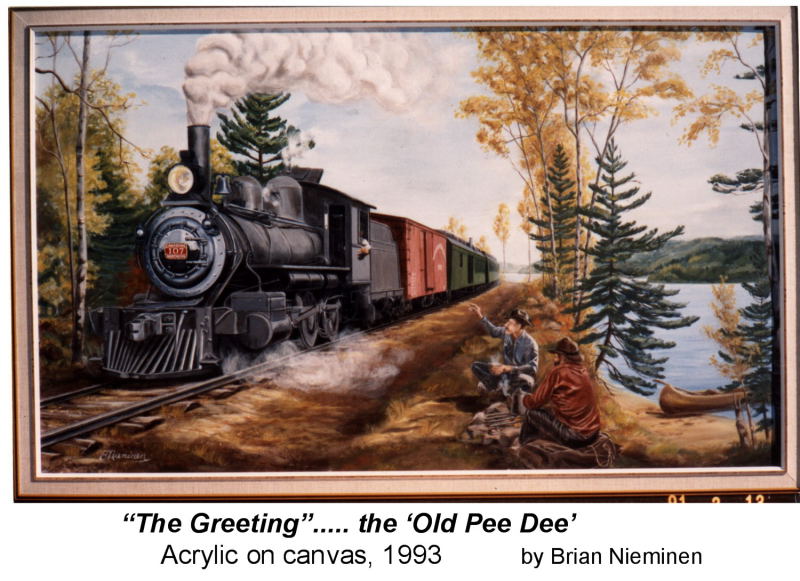
The Greeting by Brian Nieminen 1993.

This past week I received some much anticipated mail from Library and Archives Canada. Back around Christmas time I was contacted by local artist Brian Nieminen regarding the railway. Brian has had a long history with the railway; in 1993 to mark the 100th anniversary of the opening of the line, he created a painting of the railway entitled “The Greeting…the Old Pee Dee.” Since then Brian has wanted to paint an image of the most famous locomotive on the line, the Black Auntie.

The Black Auntie was the first locomotive purchased by the railway, and it was a small wood-burning 0-4-0 tender (for those of you who are interested in that stuff). She was nicknamed the “Black Auntie” as apparently there was an image of a black (can I use that, or is African-Canadian more appropriate?) madame from Port Arthur carved on her firebox door. There is currently only one known image of Black Auntie, taken while carrying passengers on an excursion during construction in 1891.
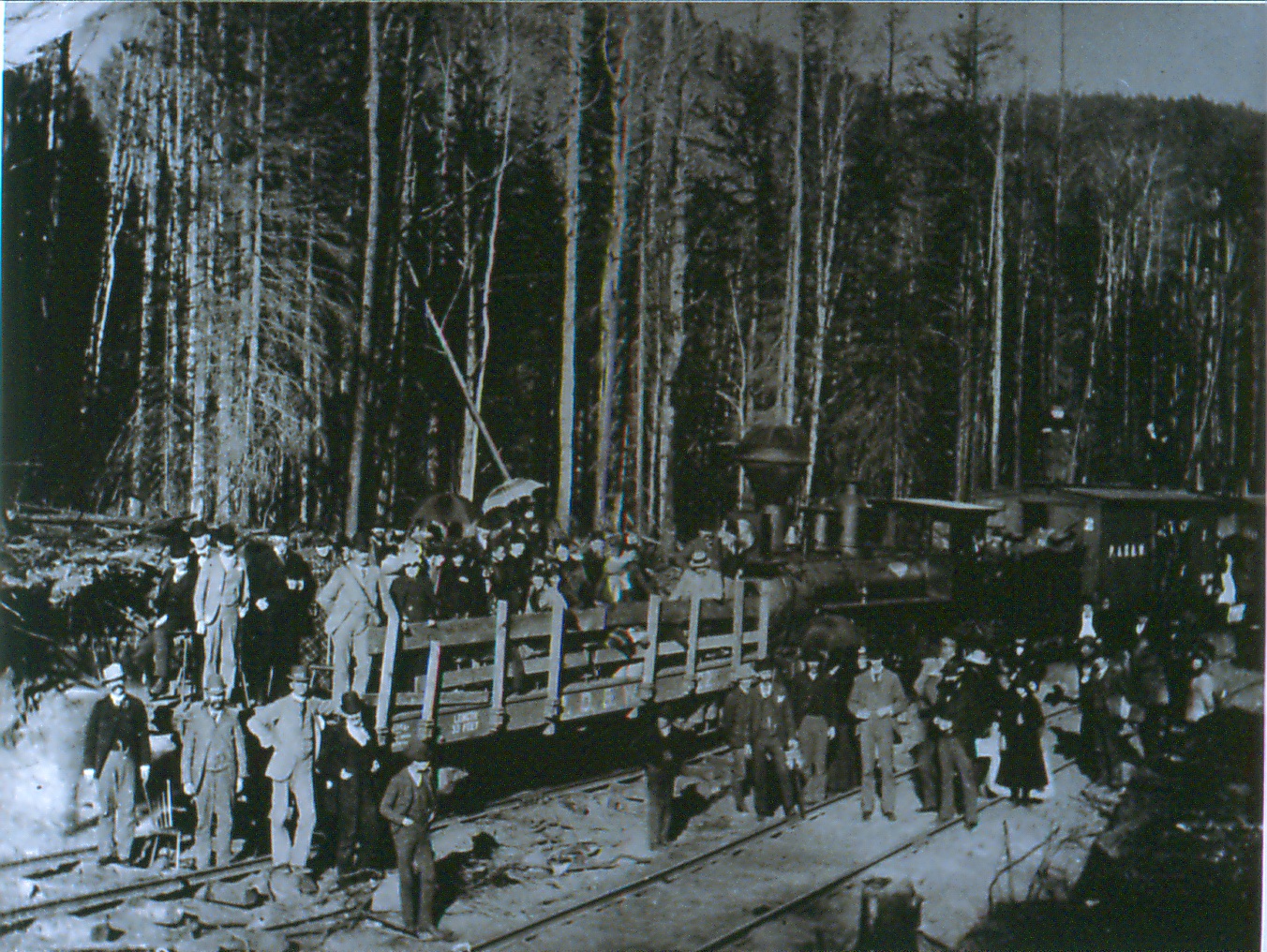
September 1891 excursion to Sand Lake.

In our conversations, Brian explained that he has held off on the painting for so long because he wanted to make sure it was done as accurately as possible. In particular he was curious to know if the image was on the front of the boiler, or on the cab firebox. My response was that I only knew of the one image, but that in the course of my research I came across an image at the archives that was titled “Port Arthur, Duluth & Western Ry. #1 at Port Arthur nicknamed Black Aunty.” Several weeks ago I decided to bite the bullet and send in a request for a digital copy of that photograph.

What arrived last Thursday was an image of a PAD&W locomotive alright, but not the Black Auntie. Immediately I recognized that this engine was a type 4-4-0, which would make it engine number 2 or 3. After reading through the specifications (I’m no train expert), I would have to say it is probably number 3, the “Lady Walton.” I immediately emailed Brian to tell him the disappointing news; I would love to see his vision of a painting of the Black Auntie crossing the bridge into Minnesota!

Turning wye at Mackies (Hymers Museum).

This past week wasn’t all disappointment however. With the warmer temperatures, the bush has dried out somewhat and that gave me an opportunity to do a bit of hiking on Saturday. I decided since the ground is still wet and the rivers and creeks a bit high, that I would go to Whitefish Lake since it is a fairly dry area. I had not really hiked this area a lot over the years, primarily because the railway runs right beside the road and there is generally not much to see. However, in my quest to gather GPS data on the whole line, I did want to mark a very prominent feature, which was a turning wye just east of Mackies.

For this adventure I was going to be joined by an old buddy, Terry, who had hiked the railway with me many moons ago. The only unfortunate part of the day was the fact that it had rained the night before, making the journey a rather wet one. We started near the Mackies Trestle (which burned in 1923) and headed east. The going was very difficult as it was more heavily grown in than I anticipated, made worse as everything was wet and slippery.
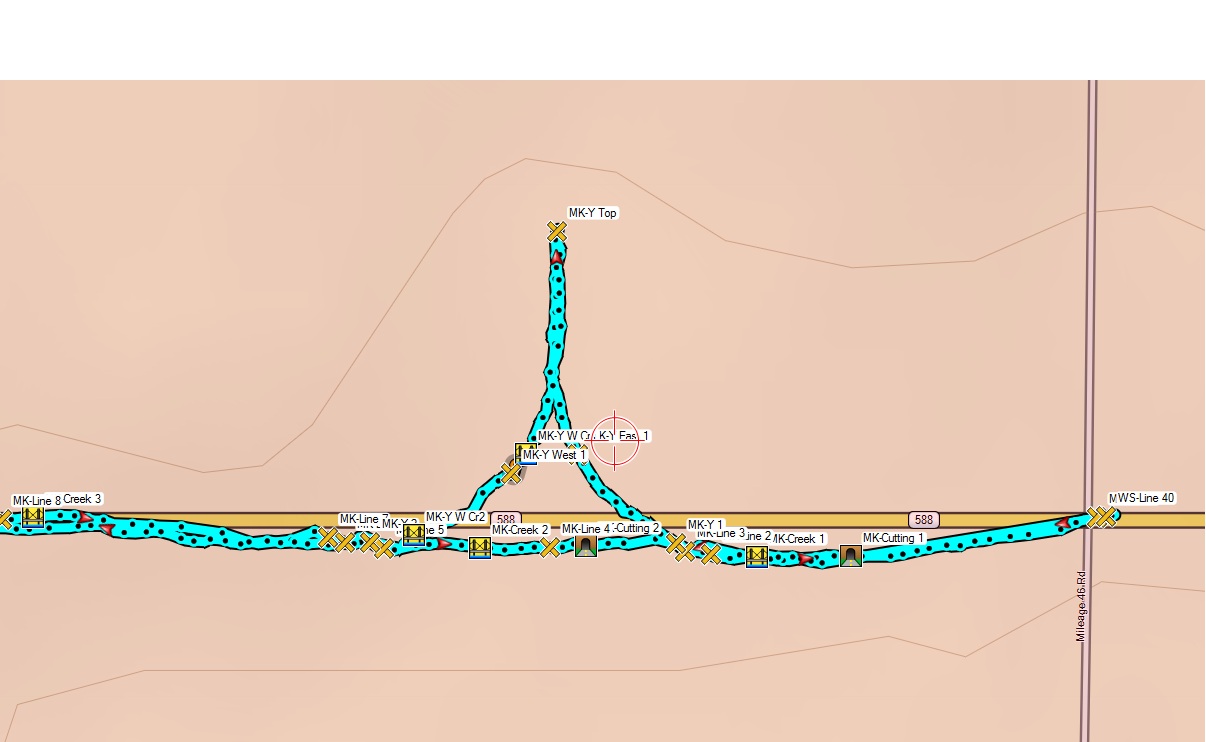
Wye screen shot.

After slugging along for about 1600 metres, I decided that we would forgo the remaining 800 metres. I had wanted to investigate the remains of a bridge over a small creek, but we were thoroughly soaked and tired from climbing over the deadfall on the rail bed. On our way back, I wanted to follow the legs of the “wye.” Resembling an inverted Y, the purpose of this track was to allow the trains to turn around. This wye had probably been installed after the Mackies trestle had burned in 1923, and the trains could no longer travel to North Lake

Junction of wye legs, Mackies 2012.

and use the turn wye there. The total length of the wye was about 500 metres, and unfortunately it was just as overgrown as the rest of the section.

As we made our way back to our starting point, we took a few minutes to examine a rare find on the line, a telegraph pole. The insulators were probably long gone, though Terry did find a shard of an insulator nearby.

That essentially ended the hike, but before wrapping things up, I showed Terry the remains of the east abutment of the Mackies trestle. I am very anxious to re-visit this section, as I

Telegraph Pole, Mackies 2012.

know there are some vehicles hiding in the brush nearby. These trucks were used the McKechnie Logging Company to transport logs from Round Lake to Mackies after the trestle burned. I think I’ll save this hike for the fall when the leaves are down and more things will be visible.

My last comments for this week offer some potentially positive news. A few weeks ago I wrote about the pending development at Gunflint Lake. Today at work I received a phone call from MPP Michael Gravelle’s office. My email did not fall on deaf ears and the Minister of Natural Resources’ office is looking into the matter. Hopefully I will receive more information in the coming weeks.

Anyway, enough for now; I need to do a few things before I call it a day. I’ll be back with more ramblings next week. Until then…
 
1 Comment

Posted by on June 11, 2012 in Hiking, Miscellaneous, Research, Writing


Tags: , , , , , , , , , , ,

Are we there yet?

No, we are not on a vacation to Kansas with Toto, but we are certainly in need of a break! I’m done! Kaput! Toast! (I could go on with the metaphors) It seems as though no matter how much sleep I get, I still wake up feeling tired. There are way too many things swirling in my head that will only go away once the school year is done. Now I know what you’re saying, poor teachers, it must be rough having the whole summer off! Well, truth be told, this occupation is getting harder to do all the time.

Once the weather begins to turn warm in April, this whole idea of “teaching” becomes much tougher to do. The nice temperatures bring with them thoughts of summer and the kids begin to lose their focus. It is now June 4th and we have completely lost them! They have no attention span, trying to do work is like pulling teeth and the senior kids just don’t show up; June is like a good month/bad month. Therefore June 29th can’t come soon enough!

I must admit though that I do have an ulterior motive; summer means that I will have time to do what I want, namely hiking the railway. Unfortunately the bush it still wet from last week’s rain, so I can’t really get out. The city continues to be in a state of emergency, since our water treatment plant is still out of action. More than a thousand homes were flooded by the rain, and I really feel for those people. I hope that things get back to normal as soon as possible.

Gravel Lake Station, June 2012.

I did get out for another drive this week, mostly to complete my task from the last drive. Moving beyond Nolalu, I marked Hillside, Silver Mountain, Whitefish, Wolfe Siding (Suomi), Mackies and Gravel Lake on Facebook. Being out there made me want to be hiking so bad; maybe I have a bit of an addiction! Or it could be that I love being in the outdoors and it gives me the peace and quiet I crave. I never really hiked a lot of the line along Whitefish Lake and my curiosity has been peaked. This area is fairly high and dry, so I might be able to get out next week.

One of my stops was at the Silver Mountain Station, one of the few remaining buildings on the line. It was built circa 1911, replacing an existing log structure and is an identical copy of the station that once stood at North Lake. For many years it has been an iconic landmark on the corner of Highways 588 and 593. During the railway era, it was home at one point to Dorothea Mitchell, the famous Lady Lumberjack. The book on her adventures makes for a very interesting read, not only chronicling some of the history of the area, but also of the life of a female entrepreneur in a frontier wilderness.

Silver Mountain Station, June 2012.

Today the station is a restaurant, recently acquired by chef and baker Shelley Simon. I had a quick chat with her on Saturday, but I need to stop by again this summer and sink my teeth into a PD burger. If you’re in the neighbourhood (or even if you’re not…the drive through the Whitefish Valley is beautiful) be sure to stop in for some great food and hospitality!

Last week I wrote about my concern for the potential development near the ghost town of Leeblain. Unfortunately I did not receive any replies to my emails, which is a bit frustrating. I know that it has only been a week, and that people have other business to attend to, but I had hoped to hear at least something. Maybe I’m used to my profession and things just operate differently. In my line of work, I’m expected to reply to messages/emails as soon as possible. Then again, I’m responsible to parents for their child’s education, so maybe there’s a bit more urgency in that!

My last news for this week is very good news. I’ve written about my planned talk at the Chik-Wauk Museum scheduled for August 5th, but I’ve managed to land something closer to home. On Friday I paid a visit to one of my old stomping grounds, the Duke Hunt Museum. Located just outside Thunder Bay in the Municipality of Oliver-Paipoonge, it will always be known to me by its old name, the Paipoonge Museum. I first visited this great little gem back in 1997 and I spent many a day there in years past. I was privileged to be able to give a few lectures at the museum back in the late 90’s.

It had been quite a while since I visited the museum, especially given that it was recently relocated to a former school just down the road. The director is a great lady by the name of Lois Garrity and it was nice to sit down and catch up with her. Our conversation naturally turned to railway and we reminisced about the presentations I had done all those years ago. It was then that Lois said, “Hey, it been a long time since you spoke about the railway, are you interested in doing it again?” To be honest, I was hoping that she would ask. Needless to say I jumped at the idea and we were able to pin down a date. So on July 25th I will make my return to the lecture world and I could not be more excited. I love to research and hike the railway, but I probably like talking about it even more!

Anyway, enough yapping for now; I’m sure I’ll have more news and things to say next week. Until then…

 
Leave a comment

Posted by on June 4, 2012 in Hiking, Miscellaneous, Research, Writing


Tags: , , , , , , , , , , , , ,

Uh, I think we have enough rain now. Thanks.

A monsoon is a seasonal prevailing wind which lasts for several months. The term was first used in English in India, Bangladesh, Pakistan, and neighboring countries to refer to the big seasonal winds blowing from the Indian Ocean and Arabian Sea in the southwest bringing heavy rainfall to the region (Dictionary.com).

Pic from the net of Vibert Road in Oliver-Paipoonge.

So you’re probably thinking, “Dave, you live in Thunder Bay and according to Dr. Koppen, it is a Humid continental (Dfb) climate (sort of)…you don’t experience monsoons!” As I demonstrate some of my geography skills in jest for you, it seems as though we do. It has been raining for the better part of five days now. It is actually quite bad; several outlying municipalities have declared emergencies today as well as the city of Thunder Bay. We have received well over 100mm of rain that have caused flooding, washouts and for the first time in my teaching career, cancelled buses. Some unfortunate people have had their basements ruined. The ditches, creeks and rivers are full of water; my backyard looks like a swamp! The sun is supposed to return on Wednesday, so let’s hope it dries up soon.

This week is the last week of May and it could not come soon enough. My burnout only seems to get worse! Football training camp starts soon and there are a whole bunch of things that need to get done before that happens. There is timetabling, graduation and a bunch of meetings still to go. I know that it will fly by, but it doesn’t make it any easier. I just need a breather!

Another picture from the net of an OPP SUV in a rather precarious situation.

All the rain doesn’t bode well for my plans to do any hiking in the near future. Rather hard to walk near rivers and lakes when they’re flooded. On Sunday I decided that since I could not hike, I would take the boys on a little drive. My one hour expedition turned into three hours, but it was all good. What could I possibly do in those wet conditions you ask? Well, my main objective was to create some places on Facebook with my phone so that I could effectively locate them when I post. I didn’t get everything done, but the Harstone Bridge, Harstone, Silver Creek, Hymers, Sellers, Leeper and Nolalu are now all officially recorded. I’m sure I’ll finish the job soon enough…the drive made me want to look at these areas sometime soon.

The most dramatic development of my week (other than the flood of course), was when I was informed that a very sensitive area of the railway is due for some development. The North-Gunflint Lake corridor is my favourite on the railway and I try to get there as often as I can (I booked my field work for August 5-8 at Gunflint). It is the farthest area from Thunder Bay and fairly inaccessible, so it has remained mostly free from human interference.

Rock oven at Leeblain, August 2011.

I received an email on Saturday that there were plans in the works to possibly open a resort on the Canadian side of Gunflint Lake, near the ghost town of Leeblain. I have spoken about Leeblain before, and it contains the remains of an old hotel and workers camp, the most important of which are several rock ovens. These ovens were used by Italian labourers on the railway to bake bread and in other places such as BC they are preserved in parks. About 2.5km west of Leeblain is the Gunflint Cross I wrote about a few weeks ago.

I’m not against the development; it would actually be nice to access Gunflint Lake without have to endure a 1 hour boat ride from North Lake or go through the US. However, I think it is critical to ensure that these important historical sites are preserved and protected. I’ve written emails to local MLA’s Michael Gravelle and Bill Mauro, as well as the local archeological review officer for the Province of Ontario; hopefully someone listens to my pleas. I will certainly mention any developments should they arise in my subsequent blogs.

Now speaking of Gunflint and Leeblain, I’ve confirmed my plans to visit the area this summer. On August 5th I will be doing my railway/mine presentation at the Chik-wauk Museum and I had hoped to conduct some fieldwork in the following days. By chance I stumbled upon long-time Gunflint summer resident and current lodge owner John Schloot. Back in the 60’s John spent many summers on Gunflint and often visited the Bishop family on North Lake and the old railway station there. He recently purchased the Moosehorn Lodge on Gunflint, which is now known as Cross River Lodge.

I’ve visited the US side of Gunflint Lake several times, staying mostly at the Gunflint Pines Resort, but I also spent an evening at the historic Gunflint Lodge. John graciously suggested that I stay at Cross River and I was more than happy to oblige. Besides, John has old films of the North Lake Station taken in the 60’s and I am very eager to see them. He has even kindly offered to provide me with a copies that I can post on my YouTube channel. The trip should be interesting since I managed to convince my wife Jo-Anne to tag along with the kids. She’s not particularly outdoorsy, so hopefully we can find some things for her and kids to do while I hike the railway. If the weather is good, it should prove to be very a memorable visit.

Anyway, I think it is about time to wrap things up. Maybe be next week the water levels will have subsided somewhat and everyone can return to a relatively normal routine. Until then…

 
1 Comment

Posted by on May 28, 2012 in Hiking, Miscellaneous, Research, Writing


Tags: , , , , , , , , , , , , ,

Well, if it wasn’t for the black flies and ticks…

“Why did God make yucky things like black flies and ticks?” asked my four-year son old Noah. “Not sure buddy, there must be a reason” was my reply (the standard answer…I am only a history teacher).

If you have no clue what I am referring to, a black fly (sometimes called a buffalo gnat, turkey gnat, or white socks) is any member of the family Simuliidae of the Culicomorpha infraorder. Ticks are small arachnids in the order Ixodida. Along with mites, they constitute the subclass Acarina. I hate both of them! (thanks to Wikipedia for the long, hard to understand scientific descriptions)

Living in northern Ontario, I’ve had to put up with black flies all my life. Most people in Canada and the northern US know what I’m talking about. They are usually most active in the spring, before things start to dry out and get too warm for them. They like to feed particularly on human blood, leaving one with small, red itchy dots at the bite location. Their most annoying trait is the swarming they do around their victim, flying into your hair (I don’t have that problem), up your nose, in your ears, eyes, wherever! Even in your mouth if it’s open…mmmmmm, tasty black fly! Unfortunately they are one of the few things that I hate about where I live.

Ticks on the other hand are a completely different story. A few years ago, no one had ever heard of a tick. There were very few of them, if any, around this area. Then things changed. It might have been the movement of more deer into this area, or more likely attributed to global warming. In any case, we now have ticks. Lots of them. My first run in with a tick happened about 5 years ago and every year it gets worse. This year is predicted to be a bad year for them, since the winter and spring were so mild. If the past few days is any indication, the forecasts are correct…I picked so many off the dog I’ve lost count.

So this weekend is the Victoria Day long weekend, which I mentioned in last week’s post is the traditional beginning of the summer season here in Canada. In my profession, it also means that summer vacation is right around the corner. And it could not come soon enough! Don’t get me wrong, I love my job, but at this time of the year everyone is a little burnt out and is in need of a refresher. I read somewhere this week (might have been on Twitter) that the old debate of re-vamping the school year is back in the spotlight. For those of you who don’t know, the school calendar was originally designed to accommodate a farming society with the months of July and August off. Yes times have changed, but the need for those two months has not.

As I already mentioned, after nine months of school (including several breaks), teachers and students are in need of a disengagement from the stress and routine of the learning environment. Time to re-charge the batteries if you like. That doesn’t mean however that all is forgotten; my gears are always turning about the next year, football, etc. Sometimes I feel like I’m not really on vacation. Weeks before the return I’m already working on things, so I don’t think I ever fully relax. So be it I guess.

So the long weekend usually means my first real hike of the season. I had been anticipating this for some time, and I was hoping that the weather would cooperate. My first order of business was to make a trip to my in-laws camp to grab the boat and motor. The camp is located about 65km east of home, and I wasn’t relishing the drive in my old truck. When I bought a new truck last year, I decided to keep the old one for trips into the bush. However, I have become a bit spoiled with the crew cab interior and leather seats!

The boys were very excited about the visit to camp; too bad the water is too cold at this time of the year! After our delicious Subway dinner (the boys would rather go to Subway than McD’s), I proceeded to load up the boat. In a precursor to the next day’s hike, I was assaulted by swarms of black flies. They made my life miserable as I tried to strap down the boat…gotta love May in the north!

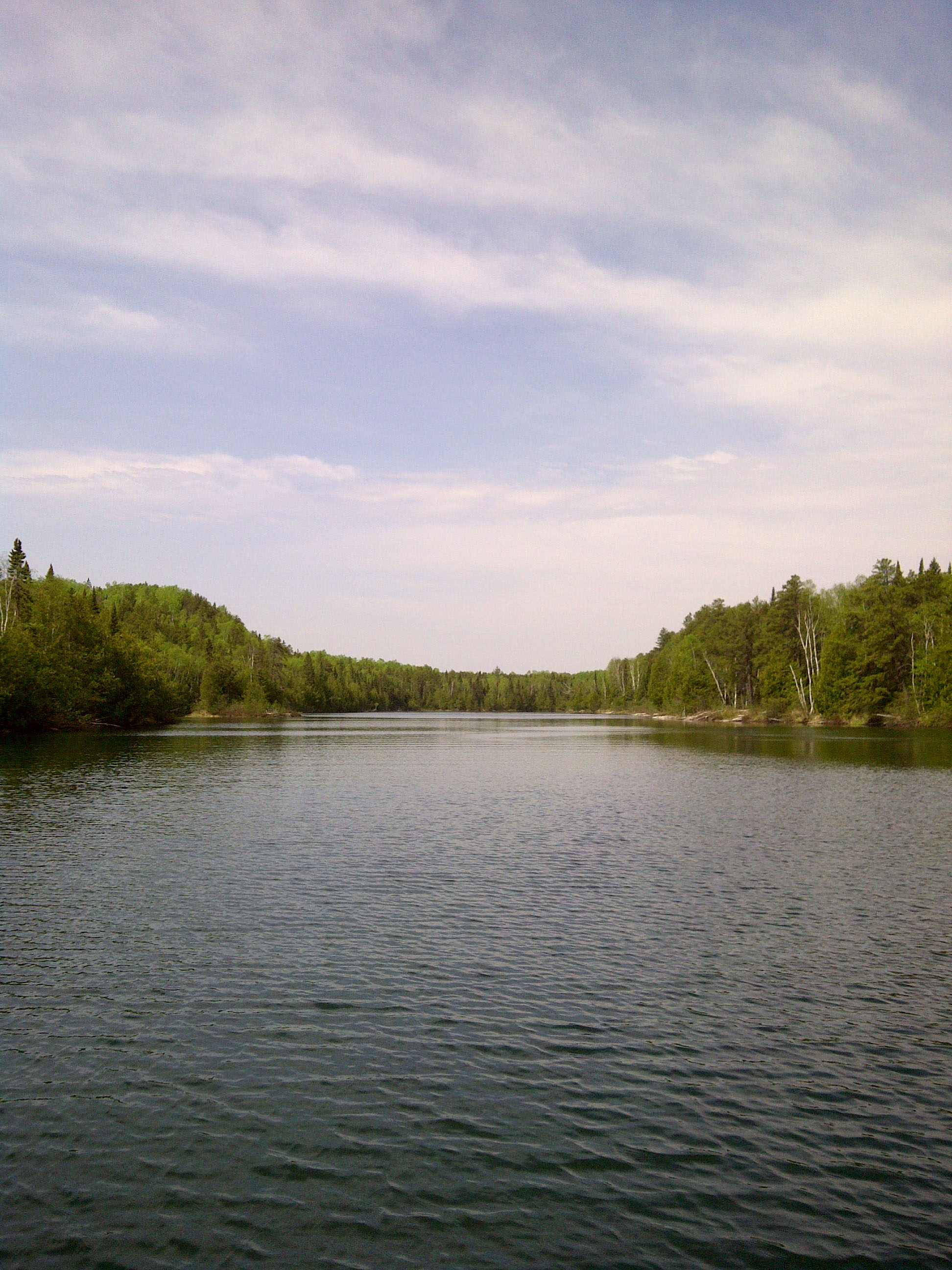
Narrows between North and Little North Lakes, with Ontario on the right and Minnesota on the left.

The drive to North Lake is about 105km, of which only just over two-thirds is paved. The drive becomes rather bumpy after leaving Highway 588 for the final 9km into the lake directly on the old grade. After unloading the boat, we began our ride to Little North Lake. Since I was only working with a 6hp motor, it took about 40 minutes to reach our destination.

This part of the railway is only accessible by boat from Canada. Mile 75 of the railway at North Lake was the location of a 1000 foot trestle that burned in 1909. The bay was originally called Goose Bay, but it is referred to as Trestle Bay in more recent times. I first visited the area west of Trestle Bay back in 1991-1992 (I can’t remember which year) after the rail bed was cleared all the way to the end of Gunflint by the Ontario Federation of Snowmobile Clubs. I guess the old grade made a perfect trail for them and all it needed was the removal of the forest growth. It was such a pristine area, as no one had been on that part of the railway in a very long time.

Besides spending some time with the boys, my main objective for this hike was to locate some old telegraph poles along the grade. These poles were put up in 1903, even after the railway (owned by Canadian Northern at the time) had decided to stop running passenger trains to Gunflint Lake. The only business past North Lake was the Pigeon River Lumber Company logging camp at the east end of Gunflint. They built their own line, the Gunflint and Lake Superior, 4.5 miles from the PAD&W at Little Gunflint Lake across the border to Crab Lake to haul logs to Port Arthur. The operation lasted until the trestle burned in 1909. The only reason to put up the telegraph line this far must have been the importance of the logging business; I wanted to confirm that it had indeed been done.

If memory serves me, I located the first pole back in 1995. I returned in 1997 to photograph and record this and another pole I located. They were in fairly decent shape. Last year I found a large coil of telegraph wire along North Lake near Trestle Bay and re-discovered the second pole on Little North, but unfortunately the cross beam had fallen off. I was determined to find that first pole, as well as a pile of discarded rails that had been left near the same spot.

Rail, Little North Lake.

Immediately after starting the hike, my son Ethan found a pile of rails north of the grade in the bush. I`d never seen these before (if I remember correctly) since they would have been obscured by the summer growth. Another short distance ahead I located a small pile of coal that had been dropped by a passing train sometime before 1909. Then five minutes later I found the rails I was looking for, but no pole (the rails are stamped M.B.H.I & S Co. 1890). The pole had obviously disintegrated in the last 12 years.

While the boys snacked on their lunch in the boat, I quickly recorded the first rails and then ran back to the

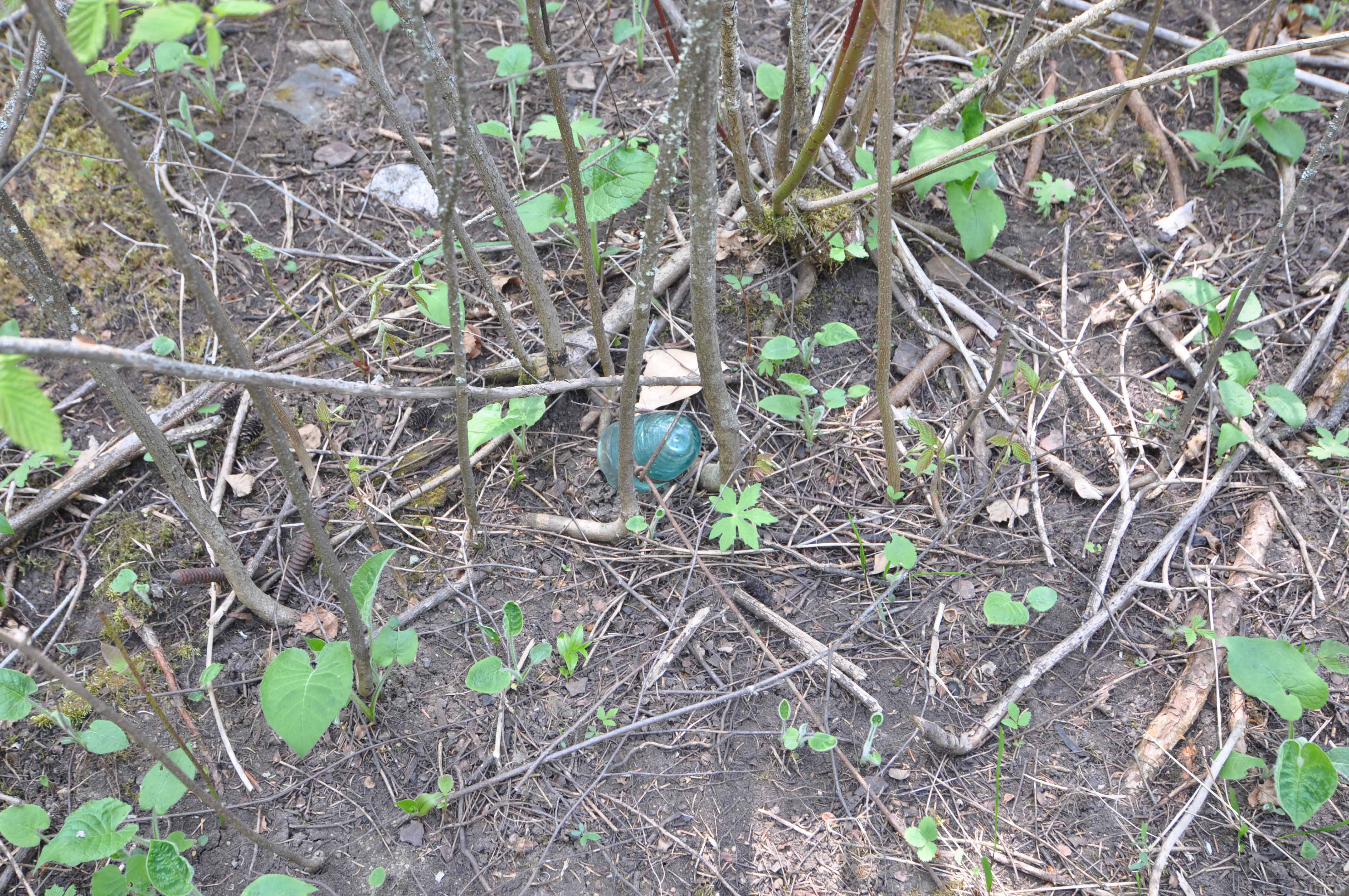
Insulator, Little North Lake.

second rails to take one last look for the pole. When I got there, I just happened to glance up from where the rails were lying and noticed something green in the background. My first thought was “no way!” Making my way over, my assumption was correct; I had found a glass insulator from a telegraph pole! In all my years of hiking I had only seen maybe a dozen poles and only found 3 insulators. The wire was still attached and examining closely I could see remains of the pole. After removing the insulator, I tried following the wire in both directions but came up empty.

Holding telegraph pole cross beam, Little North Lake.

Our second stop was a short 900m boat ride west to a second telegraph site. I saw it on two occasions last year, but I just wanted to take a quick poke around to see if I could find anything else. Unfortunately there was nothing else to see, but I did get some good pictures!

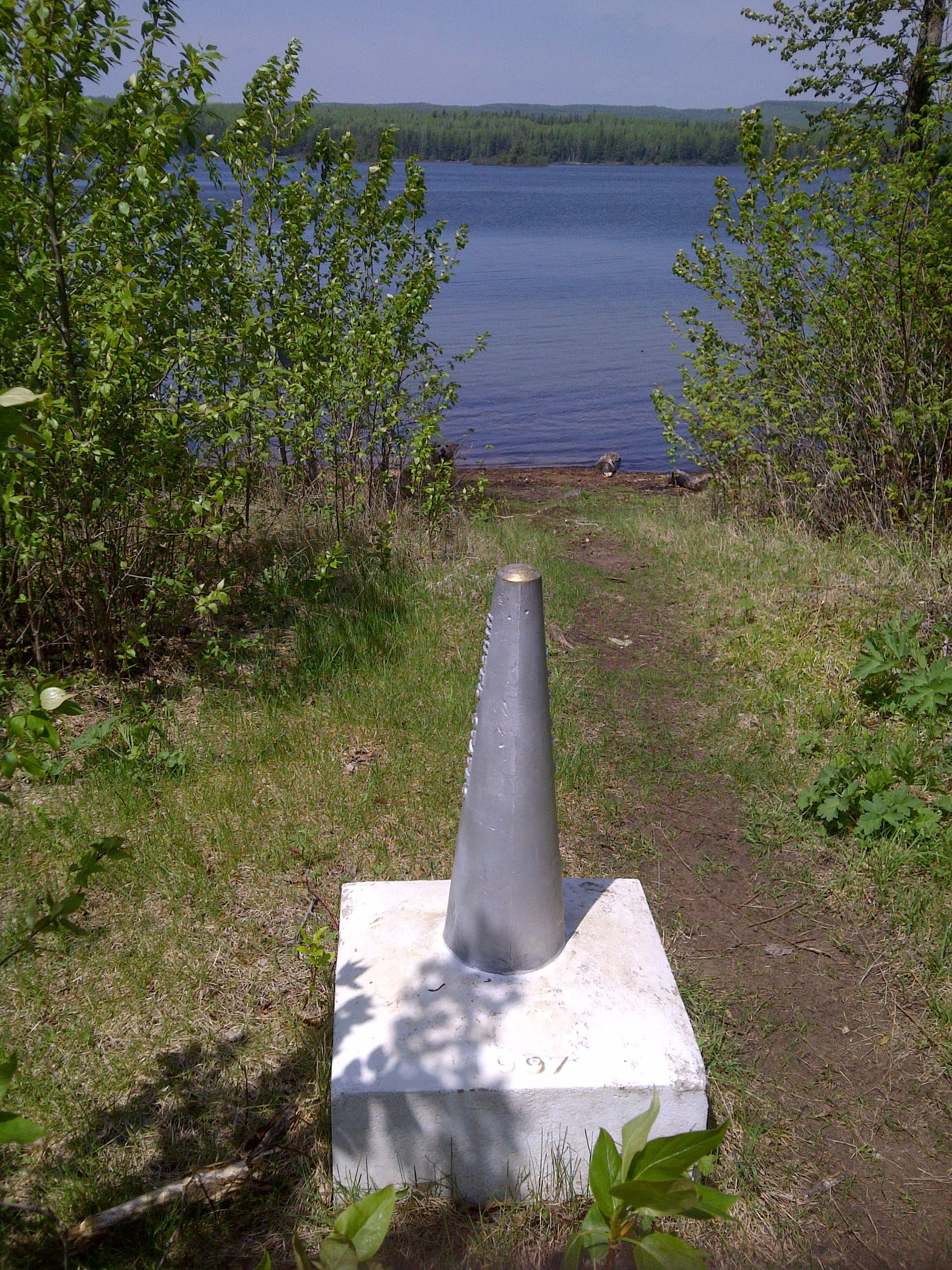
From Little North, we headed back 5km to North Lake and a visit to the Height of Land Portage. This strip of land separates North and South Lakes, as well-being the border and the Laurentian Divide (water from North flows into Hudson Bay and South flows to Lake Superior). I’ve been there many times, and there’s something to be said about wandering back and forth across the Canada-US border. In case you’re wondering, the Webster–Ashburton Treaty that finalized the imaginary delineation allows people to cross the border on the portages. So I even visited another country this weekend…all in a day’s work!

Boundary Monument. US on left, Canada on right.

Anyway, I babbled on way too long. I guess there’s a lot to say when you actually get out and do something fun. And we all look like we have chicken pox as a momento!Until then…

 
Leave a comment

Posted by on May 21, 2012 in Hiking, Miscellaneous, Research, Writing


Tags: , , , , , , , , , , ,