7:53, on the bus and ready to roll.

The graves of the Branton brothers.
Our first stop today was the Canadian War Cemetery at Beny sur Mer. There are over 2000 Canadians buried there and it was a very emotional experience again. I find it interesting that Beny, like Dieppe, is tucked away in a very quiet location. It is probably better that way. Unlike Dieppe, I did have a mission today, which was to find the graves of Gordon and Ronald Branton. Brothers from Lethbridge, Alberta, they are just one of several sets of brothers buried in Beny. Their inscription reads, “We left with a jest our home in the west. Now here with the best we lie at rest.”
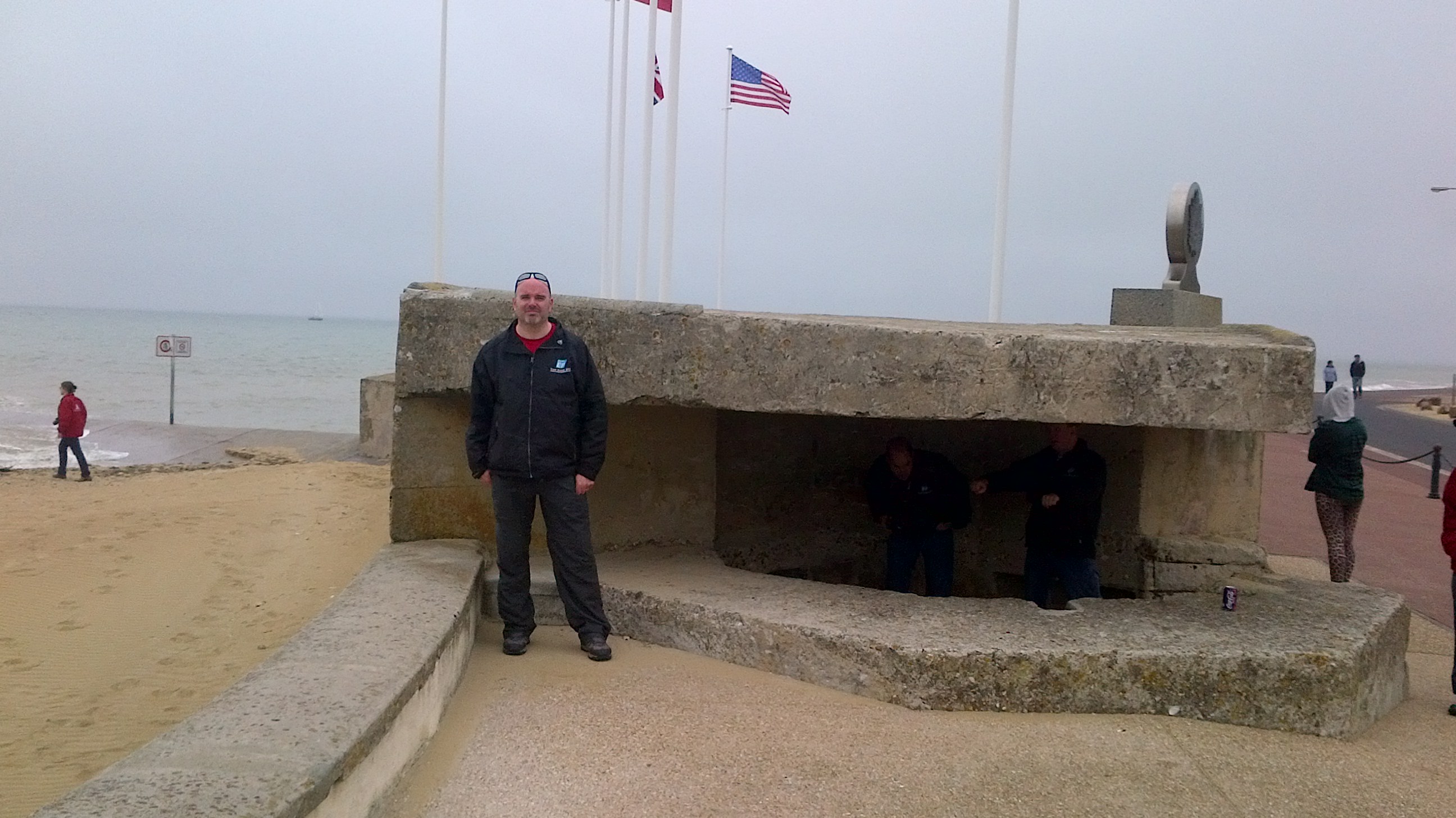
German bunker, Nan White Sector, Juno Beach.
Our next destination was Bernieres-sur-Mer, where the Queen’s Own Rifles came ashore at sector Nan White. The first house they captured is called Canada House and just down the beach is a preserved bunker adorned with the QOR logo. The Queen’s Own suffered the highest casualties of all the assault units, and looking from the bunker tells you why. Designed to enfilade the beach, it and others killed and wounded half of the QOR in minutes. I made a point of picking up some sand and rocks…almost like I’m taking pieces of Canadian history.

Grave of Major Griffin, Black Watch.
For many years I have taught my Gr. 10 students about the fighting in Normandy, and in particular the Battle of Verrières Ridge . This battle was part of a larger, unsuccessful series of attacks called Operation Spring. More than 800 Canadians were killed in Spring, and they are all buried at Bretteville. In particular, I teach them about what happened to the Black Watch (Royal Highland Regiment of Canada) at Verrieres and how the entire regiment was wiped out. The commander of the Black Watch (who was an acting commander after everyone above him became casualties), Major Phil Griffin, was blamed for the failure of the attack; I wanted to pay my respects to him.I think that it will mean more to me now that I’ve visited his grave and saw the area that was fought over.

Grave of Major Styffe, Lake Superior Regiment.
joined the local infantry reserve unit, the Lake Superior Scottish Regiment. The LSSR perpetuates the Lake Superior Regiment, which fought in Normandy as part of the 4th Armoured Division. Forty-two members of the LSR are buried at Bretteville and I thought it was my duty to try and honour them. However due to our time constraints, I was only able to visit the grave of Major Edward Styffe, who was killed in action August 14, 1944. I did pledge to myself that I would return some day and do the fallen members of the Regiment proud.

Grave of Rifleman Janson, Regina Rifles.




 Poverty, Agony, Distress & Want!